Lions, Leopards, Water Buffalo, Wart Hogs, Rhinos, Elephants and Zebras–they all drink from this river. The Mala Mala Game Reserve in South Africa was established in 1964 and is a protected wildlife sanctuary. Situated in the midst of a much larger protected area, Mala Mala is an unfenced reserve where wildlife roam free. In spite of the location, poachers still manage to kill a significant number of animals each year. Mala Mala Rangers are working tirelessly to prevent and eliminate the senseless killing of protected species such as the Rhinoceros as well as preserve an environment where wildlife may enjoy living waters. And, it really is this cool 🙂
On the Mala Mala Game Reserve, this river gives life to a myriad of species.
There are numerous cross-cultural references to the Tree of Life. I don’t know the actual name for this tree, but the symmetrical shape reminded me of drawings I’ve seen from many parts of the world. In a land teeming with such diversity of life, the symbolism was not hard to find. Africa is an amazing place, bursting with life, much of it tenuous. This tree, thriving amongst the harshness, was an inspiring reminder of my own mortality.
Standing near a watering hole, this African Elephant felt the need to make other arrangements. He dug a hole with his trunk until he struck water. Then, he drank to his heart’s content.
A thirsty African elephant takes a healthy drink from his own personal well.
The locals say the weather in Durban is the best in the world. I believe they believe it. But, when the storm brewing over the Valley of 1,000 Hills finally broke, it was like the Heavens turned over the oceans and dumped them on this valley. I can’t remember rain, no, you can’t really call it rain, maybe solid sheets of water, falling from the sky.
The Eternal City, Rome’s history spans more than 2,500 years. Founded in 753 BC., legend suggest that Romulus and Remus weren’t content to remain with the wolves, but instead founded the world’s oldest continually occupied city. When Romulus killed his brother Remus in a dispute over where the city should be, the Roman Empire was born.
I spent a day in Rome. We didn’t have a plan. We thought we didn’t need one. Everywhere you turn there is something ancient and interesting. With a church on nearly every corner, we lost track of which was which. We couldn’t go in them all. We couldn’t see them all. We could have spent weeks, months studying, learning, enjoying and capturing the beauty of this ancient city with a modern vibe. I will go back.
Designed to hold between 50,000 and 80,000 spectators, stadium builders still use the Colosseum as a pattern for modern venues.
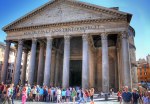
Commissioned by Marcus Agrippa during the reign of Augustus as a temple to all the gods of Ancient Rome, the Catholic Church dedicated the Pantheon to St. Mary and the Martyrs in the 7th Century.
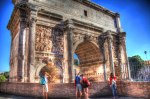
Representing the Emperor Septimus Severus’ victory in A.D. 203, this Arch still stands to welcome travelers to the glory of ancient Rome.
Legend claims that Peter was crucified upside down and Paul was imprisoned near the basilica just outside the Forum.
Ancient Rome and Catholicism coexist on top of one another.
Designed both to intimidate and illuminate, many Cathedrals in Rome provide stark contrasts between the light and the darkness.
Master works by artists such as Bernini and Michael Angelo can be found on the alter pieces of many Cathedrals throughout Rome.
Intricate stone angels and demons inspire visions of heaven and hell in many Cathedrals throughout Rome.
Intricate designs draw the eyes to heaven.
Massive stone pillars provide support near the grand entrance to St. Peter’s Square.
The height to the oculus and the diameter of the interior circle are the same, 43.3 meters.
Dedicated as a Catholic church in the 7th century, two kings of Italy are buried in the Pantheon; Vittorio Emanuele II and Umberto I.
Numerous shrines to the Virgin Mary can be found in the most unlikely places throughout Rome.
As the sun sets on the piazza, night walks begin. Historic sights in Rome are beautiful by day or night.
If my umbrella didn’t work, the naked Romans would intimidate me, too.
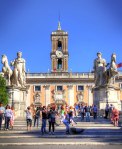
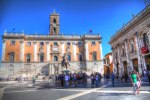
A wedding party was just gathering as we happened upon the Piazza del Campidoglio.
Intricate artwork crafted by the masters adorns the ceilings of nearly every Cathedral in Rome.
Intricate stone work and detailed artwork adorn buildings along the Via della Conciliazone, connecting Saint Peter’s Square to the Castel Sant’Angelo.
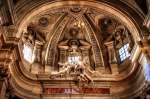
An Angel holds the golden crown of celestial glory above the Cathedral alter.
I had one day to shoot B-Roll in Rome. And, it was my birthday. My wife surprised me by flying to Rome and meeting me at my hotel. It was a great birthday present. I still had to film but we saw the sights of Rome together.
Rome has this interesting vibe of Ancient Rome overlaid with Catholic Religiosity. The people are friendly. The city is dirty. The food is good. And the places–unbelievable–almost as unbelievable as the legend of Romulus and Remus being raised by a She-wolf. Still, it is a good story–and, a great city.
The size and scale are nearly beyond belief. So are the lines to get in.
Sunlight casts shadows through the massive pillars near the entrance to St. Peter’s Square.
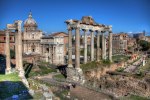
Heart of Rome and Capital of the ancient World, the Roman Forum represents the glory of a once great empire fallen to ruin.
Emperor Septimus Severus wanted the glory of his victories in battle over the Parthians in AD 203 to be remembered for all time.
In the shadows of a very old Catholic Cathedral, the ghosts of Christians past linger amidst the ruins of an ancient Roman prison.
The Piazza della Rotanda gets its name from the informal title of the Pantheon which is the church of Santa Maria Rotonda.
Nearly two-thousand years after it was built, the Pantheon dome is still the world’s largest unreinforced concrete dome.
One of the greatest achievements of Roman Engineering and Architecture, the Roman Colosseum is still the largest amphitheater in the world.
Completed in 1925, the National Monument to Victor Emmanuele pays tribute to the first king of a unified Italy.
Legend suggests that the chains housed in the central nave of Saint Peter in Chains church were actually used to bind the Apostle Peter when he was imprisoned in Jerusalem.
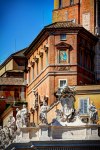
Designed by Bernini and created in 1692, the statue of Philip IV of Spain welcomes visitors to the Santa Maria Maggiore church.
Also known as the Mausoleum of Hadrian, the Castel Sant’Angelo was commissioned by the Emporeror Hadrian and was later used by the Popes as a fortress.
Statues on the bridge, Ponte Vittorio Emanuele II, look over the Tiber River as pedestrians, vehicles and boats pass by.
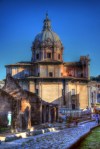
A restoration project underway, Trajan’s Forum reveals ancient secrets in the midst of a crowded contemporary neighborhood.
Late afternoon sun shines Heaven’s light throughout a Cathedral nave.
An Angel holds the golden crown of celestial glory above the Cathedral alter.
Residing in the Church of St. Peter in Chains, the Grim Reaper eventually visits us all.
It was my birthday. Anne surprised me by coming to Rome. We threw coins over our shoulders and kissed. We will return.
Whether or not Marie Antoinette actually said, “Let them eat cake,” is up for debate. What isn’t up for debate is the fact that the French Aristocracy of the 17th century had lost touch with the plight of the common folk. In 1682 King Louis XIV moved the center of political power in France from Paris to Versailles. His heir, Louis the XV and his heir, Louis the XVI, expanded the elaborate and exquisite palace in a decadent game of one-upmanship, each seeking to outdo the extravagance of the last. The Château, or Castle, or Palace of Versailles represented the system of absolute monarchy in the divine right of kingship.
The people had no bread. Yet the Kings inlaid gold throughout their palace and threw elaborately expensive balls. For this very reason, it may be possible to understand why, on October 6, 1789 the Royal Family was forced to leave Versailles for the Tuileries Palace in Paris as a result of the Women’s March on Versailles and the erupting revolution. Not long after, in spite of lofty ideals, the people’s French Revolution removed the heads of those who ignored the basic humanity of their subjects instead choosing art and architecture over liberty and life.
As I visited the marvelously decadent and brilliantly ostentatious palace, now a historical museum, I felt that traditional photographic images did not rise to the same level of ornate excess demanded by the creators of Versailles or by the palace itself. So, I look through the lens wishing it were canvas and brush, hoping that the images could transcend the common and rise, with the ghosts of Versailles, to the courts of Art.
The Palace of French Kings
Near the entrance to the Palace Grounds, a quaint provincial cottage guards the iron gates.
Used as a military hospital in World War I, this luxury hotel was my home for the short time I spent in Versailles.
Iron gates prevent unwary tourists from entering the garden maze and getting lost forever.
Symmetrically groomed lanes on the Palace grounds provide ample opportunity for gentle country strolls.
A gentle stroll for quiet contemplation or a challenging jog for peak conditioning, the Palace lanes of Versailles offer the perfect environment for physical or mental conditioning.
Fountains and gardens adorn the Palace grounds at Versailles.
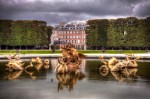
Surrounded by dolphins and cupids, young Apollo slays the dragon.
From the dreams of Greek philosophers, statues and trees lead to the heart of French Culture, symbolic tree of life, the Château de Versailles.
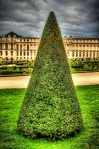
Precisely pruned pillars point to heaven while standing guard on approach to Versailles.
An evergreen sentinel points toward heaven outside the Palace of Versailles.
Evergreen soldiers await the command to march on the Palace.
A Grecian Goddess of Versailles ironically holds the flame of freedom in her hand.
In the Palace Garden, the four seasons (three visible) are represented by Grecian like statues.
KIngs and Courtiers still bask in the lavish extravagance of the Château de Versailles.
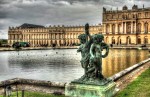
Statue symbolizing one of the four rivers of France, the pool reflects sunlight up to the hall of mirrors.
Legends of the Greeks express the dreams of French Kings.
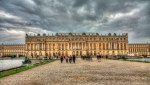
The Palace of Versailles from the rear.
Louis IV transformed his father’s hunting lodge into the seat of French government in 1682.
Begun as a hunting lodge by Louis XIII, the Central Courtyard grants entrance to one of the most lavish palaces in history.
Marble courtyard at the heart of the Palace of Versailles, grants entrance to the King’s private chambers.
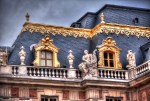
Inlaid gold embroiders the exterior of the King’s bedroom on the Palace of Versailles.
It took three years to build the Pyramid Fountain near the Grand Palace of Versailles.
On the Palace grounds, the Grand Canal is 1,670 meters long and took eleven years to build, from 1668 to 1679.
Paris is a vibrant city,rich in tradition, culture and history. As I spent time, not nearly enough, in the city, I felt the stories, written in the walls, stones and walkways. I couldn’t help looking through my lens to capture, not what I saw, but what I felt. High dynamic range photography seemed to be the only way I could bridge the gap between my dreams and my abilities. HDR images provided some relief from the need to capture the singular light of this marvelous city on canvas. I have no skill with the brush. I must rely on pixels to form the images I can only imagine amidst the landmarks which call to me in my sleep.
At the tip of the Chanps-Élysées, Napoléon’s arch is still the center of any Parisian parade.
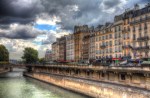
One of the islands on the Seine, near the birthplace of Paris.
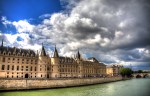
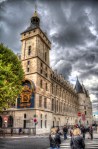
This castle served as one of the earliest homes for French royalty.
With the bridge across the Seine visible in the distance, this castle served as one of the earliest homes for French royalty.
Quasimodo may still live in these imposing towers.
View of Notre Dame from the Seine River.
A view of the Cathedral of Notre Dame form the rear.
View from the River Seine.
Scenic apartments contribute to the Paris sensibility.
Not far from Notre Dame, Sainte-Chapelle was built by order of King Saint-Louis.






























 They're Calling To Me