Home of the ancient Roman seaport, Ostia is a beautiful resort destination on the Tyrrhenian Sea and the mouth of the Tiber River.
Lido di Ostia, or Lido di Roma is a beautiful resort destination on the Tyrrhenian Sea and the mouth of the Tiber River. Ostia was the ancient seaport of Rome. Due to the buildup of silt and the passing of time, the actual Roman seaport is now several kilometers from the sea. But, the warm Mediterranean breezes still blow across a resort village community not far from the heart of both ancient and modern Italy. When I go back to Rome, and I will, I hope to spend more than an afternoon soaking up the sun, sand and warmth of this beautiful Italian community.
I thought, since it is New Years Eve, I would post a photo gallery of shots from some of the places I’ve been around the world. Sort of a “Best of” gallery from previous posts. I’ve been only blogging since August, so I have yet to post shots from everywhere I’ve been. And, I have yet to even start posting video from all of these places. That is what 2014 is for. Resolution 🙂
The world is a big, beautiful place, filled with interesting people, amazing sights, random coincidences and occasional tender mercies. I have been blessed to travel. I have been blessed to make friends on every continent. I hope to keep the friends I have made and make more as time goes by. However, my greatest blessings are found at home, with a warm fire, a good meal and my family, who love me.
I hope you enjoy the photographs. Happy New Year.
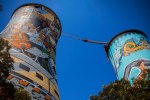
Soweto Towers could be one of the coolest places in the world to bungee and base jump.
Corregated metal, cardboard, canvas and the ever-present barbed wire makeup the materials of most houses in the township.
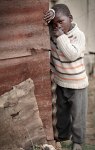
Without education, children growing up in the township face limited opportunities.
The Village Elder gave us permission to take a picture, but, the women of the village, the mothers wouldn’t come out of their huts to be in the shot.
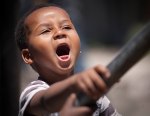
A child can find pure joy amidst the most challenging of circumstances.
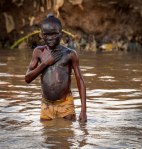
The secret to such smooth, smooth skin could be found in the mud of Lubumbashi River.
Working with root fibers in Yamoransah village, Ghana.
When I tried to take her picture, she would hide her face and then laugh. When I showed her pictures of her friends, she opened up enough to let take this photo.
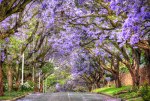
Jacaranda trees bloom in spectacular beauty on a residential street in Johannesburg, South Africa.
The legendary tree of life thrives in Africa.
A thirsty African elephant takes a healthy drink from his own personal well.
Leopard finishing a meal of Impala at the Mala Mala Game Reserve, South Africa.
One of the greatest achievements of Roman Engineering and Architecture, the Roman Colosseum is still the largest amphitheater in the world.
Kneeling in the attitude of penitent prayer, this woman remains still for hours, hoping her prayers will be answered with coins in her cup.
Late afternoon light illuminates a common staircase adjacent to the Scala Sancta (Holy Steps) said to be the steps Jesus stood upon before Pontius Pilate.
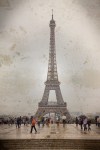
A vintage rainy day in Paris.
KIngs and Courtiers still bask in the lavish extravagance of the Château de Versailles.
Evergreen soldiers await the command to march on the Palace.
One of the islands on the Seine, near the birthplace of Paris.
A woman rests from her burdens.
Can you say Da Vinci Code?
The heart of the ancient Inca Empire
Scones and Smiles, she’ll warm your heart with both.
Shape, pattern, line and light emerge through a high-dynamic-range look into the meadow.
Early morning sun shines on Lone Peak, Wasatch Mountains, Utah.
Temple Square in Salt Lake City is the headquarters of The Church of Jesus Christ of Latter-day Saints. Construction of the Salt Lake Temple began in 1847 and took nearly 40 years to complete. The Temple, surrounded by thousands of twinkling Christmas lights, stands as a symbol of faith and hope to more than 15 million Latter-day Saints (Mormons) across the world.
Corregated metal, cardboard, canvas and the ever-present barbed wire makeup the materials of most houses in the township.
“What was it like,” I asked him, “apartheid?”
Joseph. Our driver. He was a large, jolly man in his fifties. He had dark chocolate skin with curly, salt and pepper hair. He looked at me and the smile lines around his eyes wrinkled.
He laughed.
Without education, children growing up in the township face limited opportunities.
Not just a chuckle. Joseph burst into a full belly laugh. He had lived through it. He was 33 when Apartheid ended.
“You would not believe me if I told you,” Joseph said. “My children do not believe me when I tell them.”
At first, I didn’t understand why he was laughing. I didn’t understand how he could laugh. It wasn’t funny.
“Tell me.”
“No.”
I pressed him.
“It was horrible. No freedom. No jobs. We had no hope.”
In the Township, 3000 people share three water taps.
He drove us to a township just outside of Johannesburg.
“Three-thousand people live here,” he said. “They have no running water. They have no electricity. They share three water taps. They share 20 portable toilets.”
He introduced me to the people. They were quick to smile, but their eyes were guarded, skeptical. I couldn’t understand their words. Joseph translated.
Who is this white face with a camera?
With no running water or sanitation, 3000 people share 20 portapotties throughout the township.
Why does he take our picture?
Joseph told them I was there to tell their story. I was. They were glad. They were friendly. They wanted me to understand. They wanted others to know of their struggle. For them, Apartheid was not over.
I was stunned. They had so little.
“Why?”
Child rearing falls to the women. The traditional wrap makes an excellent baby backpack.
“Get in the car.” Joseph said it was time to go. It was no longer safe.
I got in the car.
Joseph did not laugh.
“Apartheid ended in 1994. Those were difficult times. I lost my best friend to a gunshot. I cannot describe…I will not describe those days. We did not know if we would live or die. We had no hope.”
“But, Apartheid has been over for 27 years.”
“These people believe the government will take care of them. They think the government will educate them.”
“Will they?”
Joseph laughed. “They say apartheid is over. It is not. But at least now we have hope.”
Having recently visited South Africa, I was reflecting on my experiences there in light of Nelson Mandela’s passing. A courageous, inspiring leader, he had an influence on a people, a country and a world. As I met the people, talked with them, broke bread with them, photographed them, Nelson Mandela had an influence on me. I came to admire his commitment to moral principles which elevate the human condition. I found, in Johannesburg, a complex and complicated city with contrasts not entirely in keeping with Nelson Mandela’s vision for how things ought to be. In other parts of the country these contrasts were even more apparent. Things are not how they should be. Yet, I also saw hope, commitment, energy and progress. I’m sure Nelson Mandela didn’t accomplish all he hoped to accomplish in his long and influential life. Yet, his vision took root. His commitment and perseverance inspired others. Nelson Mandela made a difference. South Africa made a significant impression on me well beyond the images I took.
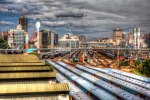
Completed in 2003 at a price of 38 million rand, the Nelson Mandela Bridge was conceived as a means of bridging two disparate parts of Johannesburg in the hopes of revitalizing the inner city.
Jacaranda trees bloom in spectacular beauty on a residential street in Johannesburg, South Africa.
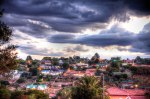
Johannesburg, South Africa is a colorful and diverse city. We stopped for a moment to capture the sunset over this neighborhood.
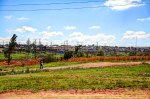
Powerlines traverse the horizon as a Soweto resident walks home along the dirt path leading to the Township.
Life in the township has improved, but can still be difficult. Growing crops provides an income supplement and food for a family.
Bungee jumpers and base jumpers get their adrenalin rush by leaping from the platform bridge between the Two Towers.
Johannesburg is a beautiful city. From a distance and height, the views are stunning.
Afternoon and evening storms, sometimes violent, roll in over Johannesburg, relieving the city of heat and humidity.
Johannesburg downtown business district is clean, modern and growing.
With seating for 37,500, Johannesburg stadium is home to the Orlando Pirates Football Club and the Golden Lions Rugby Union.
Johannesburg has a modern well developed infrastructure.
Alexandra Township, or Alex, is part of Johannesburg, South Africa, and is one of the poorest urban areas in the country.
As this woman crossed the bridge, I asked if I could take her picture. When I showed her the picture, she laughed and laughed. She couldn’t understand why I wanted her picture.
While economic opportunities abound in Johannesburg, the unemployment rate among blacks is astronomically high, somewhere near 32%.
They seemed like bars, the wooden frames. To keep me out or hold him in, I did not know which was more damning.
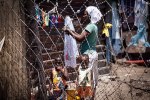
Ever present and visible on nearly every home, regardless of class, barbed wire speaks to the underlying crime and lack of security every resident of Joburg faces.
In Alex, unemployment, drugs, gangs and violence are part of the landscape of daily life. Barbed wire is one small means of protecting the children.
Water is a scarce commodity in many parts of the world. Clean water is even more precious. In Alex, dirty water is plentiful.
This building was abandoned. Now squatters take up residence as the building slowly decays.
Storm brewing over the Valley of 1,000 Hills.
The legendary tree of life thrives in Africa.
A thirsty African elephant takes a healthy drink from his own personal well.
Friendly rhinoceros grazing on the Mala Mala Game Reserve.
Leopard finishing a meal of Impala at the Mala Mala Game Reserve, South Africa.
7:45 am, 28 degrees, Thanksgiving morning, 5K run. I was the designated photographer as three of my children dragged me out of bed to take pictures of them running. Annual tradition. Most all of my family converged on our home for Thanksgiving. With so many people staying in our home, there hasn’t been much sleeping going on. I stayed up way too late. I was tired. I was cold. Then, the sun came up. The light hit the mountain tops and I thought about all the places I have been in the world this year, how many frequent flyer miles I have accrued, how many Marriott points I have, and, I was glad. Glad to be home. Home where the cold November mornings chill my breath. Home where the sun shines more often than not and the summer sun shines late and long. Home where my pillow fits my head and my bed has an indentation just my size. Home where my children come for Sunday dinners. Home where the sun rises over the Wasatch mountains to the east and Lone Peak Mountain lies north. Home, where I’m never lost and always loved. For these things and more I give thanks.
Early morning sun shines on Lone Peak, Wasatch Mountains, Utah.
They say Africa changes you. If you’ve been to Africa, spent time there, visited the people, you will understand. I’ve been to Africa four times. This was my first time in Lubumbashi. I was surprised. My own stereotypes were both reinforced and shattered. In Lubumbashi, a fragile peace hung over the city as oppressive as the heat and humidity, infusing a cultural angst almost as heavy . I was the outsider. I was different. The children called me “Muzungu”, white face, not a compliment. They smiled and laughed, not with me. My camera lens brought them running, surrounding me, dancing, playing and posing. In their eyes I saw joy, and innocence. The adults looked on, skeptical, questioning, challenging. Their eyes were reserved, hooded, holding back, keeping their stories from me. Many turned away. Some shouted insults. Those that did not were watching to see what I would do with their likeness. I took their pictures. I took them with me. I took them in, a part of me. I will not forget. In their African eyes I will never be the same.
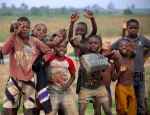
These boys could not resist posing for the camera as we left their homes on the Lubumbashi River.
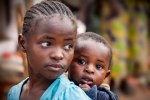
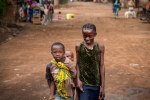
Shouldering many of the parenting responsibilities, a young girl carries her baby brother on her back.
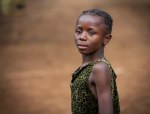
Stylishly dressed in a green leopard print, this young girl has just one dress.
Her dress didn’t fit. The buttons were missing, but, she was still beautiful.
He’d just come out of the river, the mud still on his face. My camera drew him to me, with all his friends. The children called me Muzungu–white face.
When I showed him this picture, he laughed and laughed. So did his buddies.
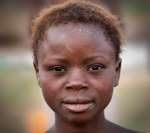
When I tried to take her picture, she would hide her face and then laugh. When I showed her pictures of her friends, she opened up enough to let take this photo.
They were inseparable. She was delightful. He was protective.
Joyful–I couldn’t help but smile in her presence.
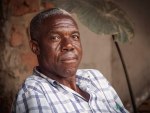
Who was I? Why was I there? I could feel the quiet challenge in his stare.
He wanted me to see his basketball jersey–the LA Lakers. I don’t think he knew anything about basketball, or the Lakers. The Jersey was purple, and it came from America. We had something in common. He was proud of that.
Some NGO dropped used clothing on the banks of the river. The children chose the brightest. Washing in the Lubumbashi river keeps those colors clean and vibrant.
Hurrying to see what the commotion surrounding us was all about, he came out of the river, still dripping.
The secret to such smooth, smooth skin could be found in the mud of Lubumbashi River.
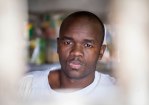
After interviewing his nephew, I held up my camera and pointed toward him. He nodded and I took his picture. His eyes tell stories I’ll never hear.
A popular gathering place for Congolese, the town square has both political and artistic significance for residents of Lubumbashi.
Inconspicuously holding up the wall of his home, a shy young boy waits with his cat.
In one of the nicer homes in Lubumbashi, this kitchen features a few pots and a charcoal barbecue for cooking.
A tangible symbol of the province’s mining industry, Lubumbashi Mountain rises above the farms and villages surrounding the city.
Lubumbashi Mountain is made from the left over materials from the mines surrounding Lubumbashi.
With much practice and good posture, you too can learn to carry your worldly possessions on the top of your head.
It was hot in Lubumbashi, and humid. When the storm finally broke and the rain poured down, it turned the roads to mud.
Thatched roofs and termite mound bricks make up the main ingredients of huts in Bande Village.
The Village Elder gave us permission to take a picture, but, the women of the village, the mothers wouldn’t come out of their huts to be in the shot.
Women and children gather on the banks of the Lubumbashi river to do their laundry.
The Lubumbashi River is the local bathing, swimming and washing place, as well as the source of drinking water and sanitation removal.
Older sister and two brothers walk through their neighborhood.
Boys watch and wonder what we are doing with our really big cameras.
This boy was full of life and laughter, posing for our cameras.
This boy watched us carefully and curiously, not approaching, yet, not withdrawing.
Unemployment is high in Lubumbashi. Many young men simply can not find work.
About a half-hour drive outside of Lubumbashi, Democratic Republic of the Congo, is a little village called Bande. They grow avocados and fruit and sell them by the roadside to survive. We stopped for a visit. The children immediately surrounded us. They spoke Swahili and French. I spoke neither. With help, we asked the village Elder for permission to take this photo. He smiled and nodded agreement. I thought, for a moment, that the one woman in the shot was the mother. Not so. She is the older sister. The women of the village would not come out of their termite-clay-brick huts. The three men in the shot were the older brother, the uncle and the neighbor. The Elder also would not be in the shot. He was standing beside me looking at my view finder. With a small purchase, you can make friends for life in Bande Village.
The Eternal City, Rome’s history spans more than 2,500 years. Founded in 753 BC., legend suggest that Romulus and Remus weren’t content to remain with the wolves, but instead founded the world’s oldest continually occupied city. When Romulus killed his brother Remus in a dispute over where the city should be, the Roman Empire was born.
I spent a day in Rome. We didn’t have a plan. We thought we didn’t need one. Everywhere you turn there is something ancient and interesting. With a church on nearly every corner, we lost track of which was which. We couldn’t go in them all. We couldn’t see them all. We could have spent weeks, months studying, learning, enjoying and capturing the beauty of this ancient city with a modern vibe. I will go back.
Designed to hold between 50,000 and 80,000 spectators, stadium builders still use the Colosseum as a pattern for modern venues.
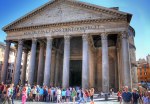
Commissioned by Marcus Agrippa during the reign of Augustus as a temple to all the gods of Ancient Rome, the Catholic Church dedicated the Pantheon to St. Mary and the Martyrs in the 7th Century.
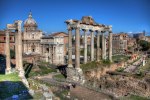
Representing the Emperor Septimus Severus’ victory in A.D. 203, this Arch still stands to welcome travelers to the glory of ancient Rome.
Legend claims that Peter was crucified upside down and Paul was imprisoned near the basilica just outside the Forum.
Ancient Rome and Catholicism coexist on top of one another.
Designed both to intimidate and illuminate, many Cathedrals in Rome provide stark contrasts between the light and the darkness.
Master works by artists such as Bernini and Michael Angelo can be found on the alter pieces of many Cathedrals throughout Rome.
Intricate stone angels and demons inspire visions of heaven and hell in many Cathedrals throughout Rome.
Intricate designs draw the eyes to heaven.
Massive stone pillars provide support near the grand entrance to St. Peter’s Square.
The height to the oculus and the diameter of the interior circle are the same, 43.3 meters.
Dedicated as a Catholic church in the 7th century, two kings of Italy are buried in the Pantheon; Vittorio Emanuele II and Umberto I.
Numerous shrines to the Virgin Mary can be found in the most unlikely places throughout Rome.
As the sun sets on the piazza, night walks begin. Historic sights in Rome are beautiful by day or night.
If my umbrella didn’t work, the naked Romans would intimidate me, too.
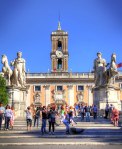
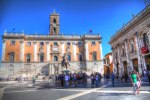
A wedding party was just gathering as we happened upon the Piazza del Campidoglio.
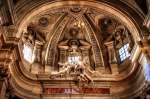
Intricate artwork crafted by the masters adorns the ceilings of nearly every Cathedral in Rome.
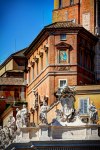
Intricate stone work and detailed artwork adorn buildings along the Via della Conciliazone, connecting Saint Peter’s Square to the Castel Sant’Angelo.
An Angel holds the golden crown of celestial glory above the Cathedral alter.
Whether or not Marie Antoinette actually said, “Let them eat cake,” is up for debate. What isn’t up for debate is the fact that the French Aristocracy of the 17th century had lost touch with the plight of the common folk. In 1682 King Louis XIV moved the center of political power in France from Paris to Versailles. His heir, Louis the XV and his heir, Louis the XVI, expanded the elaborate and exquisite palace in a decadent game of one-upmanship, each seeking to outdo the extravagance of the last. The Château, or Castle, or Palace of Versailles represented the system of absolute monarchy in the divine right of kingship.
The people had no bread. Yet the Kings inlaid gold throughout their palace and threw elaborately expensive balls. For this very reason, it may be possible to understand why, on October 6, 1789 the Royal Family was forced to leave Versailles for the Tuileries Palace in Paris as a result of the Women’s March on Versailles and the erupting revolution. Not long after, in spite of lofty ideals, the people’s French Revolution removed the heads of those who ignored the basic humanity of their subjects instead choosing art and architecture over liberty and life.
As I visited the marvelously decadent and brilliantly ostentatious palace, now a historical museum, I felt that traditional photographic images did not rise to the same level of ornate excess demanded by the creators of Versailles or by the palace itself. So, I look through the lens wishing it were canvas and brush, hoping that the images could transcend the common and rise, with the ghosts of Versailles, to the courts of Art.
The Palace of French Kings
Near the entrance to the Palace Grounds, a quaint provincial cottage guards the iron gates.
Used as a military hospital in World War I, this luxury hotel was my home for the short time I spent in Versailles.
Iron gates prevent unwary tourists from entering the garden maze and getting lost forever.
Symmetrically groomed lanes on the Palace grounds provide ample opportunity for gentle country strolls.
A gentle stroll for quiet contemplation or a challenging jog for peak conditioning, the Palace lanes of Versailles offer the perfect environment for physical or mental conditioning.
Fountains and gardens adorn the Palace grounds at Versailles.
Surrounded by dolphins and cupids, young Apollo slays the dragon.
From the dreams of Greek philosophers, statues and trees lead to the heart of French Culture, symbolic tree of life, the Château de Versailles.
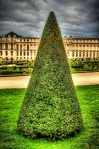
Precisely pruned pillars point to heaven while standing guard on approach to Versailles.
An evergreen sentinel points toward heaven outside the Palace of Versailles.
Evergreen soldiers await the command to march on the Palace.
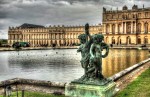
A Grecian Goddess of Versailles ironically holds the flame of freedom in her hand.
In the Palace Garden, the four seasons (three visible) are represented by Grecian like statues.
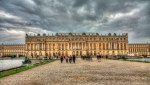
KIngs and Courtiers still bask in the lavish extravagance of the Château de Versailles.
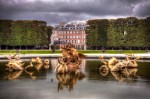
Statue symbolizing one of the four rivers of France, the pool reflects sunlight up to the hall of mirrors.
Legends of the Greeks express the dreams of French Kings.
The Palace of Versailles from the rear.
Louis IV transformed his father’s hunting lodge into the seat of French government in 1682.
Begun as a hunting lodge by Louis XIII, the Central Courtyard grants entrance to one of the most lavish palaces in history.
Marble courtyard at the heart of the Palace of Versailles, grants entrance to the King’s private chambers.
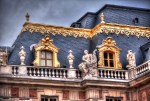
Inlaid gold embroiders the exterior of the King’s bedroom on the Palace of Versailles.
It took three years to build the Pyramid Fountain near the Grand Palace of Versailles.
On the Palace grounds, the Grand Canal is 1,670 meters long and took eleven years to build, from 1668 to 1679.
So much to see, so little time. With so many sites, the challenge was to really see, to look for the commonplace and see the unique vibrance hidden beneath the rush. Judge for yourself. I was inadequate, overwhelmed, rushed. A feast before me, I had little time to decide of what to partake. Yet, I came away filled.
The Metro was our friend and we walked, and walked, and walked…and the sun went down.
A vintage rainy day in Paris.
Perhaps one of the most famous and most expensive streets in France.
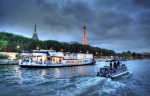
Two boats pass at dusk, on the Seine River.
Stone steps make for good reading.
A woman strolls past the symbols of Parisian ethnic diversity.
On the way to Paris.
At last, we found it.
A rainy day outside the Château du Louvre
A window flower box fades in early fall weather.
A street performer serenades Parisian lovers with the accordion, long a symbol of Parisian music.
The Paris subway is convenient and economical.
A cool way to exit the Metro
The Paris Metro provides a convenient and economical way to see the sites.
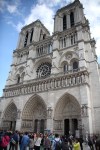
Tourists mass outside the Cathedral of Notre Dame.
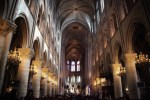
Inside the gothic Cathedral de Notre Dame.
Just in case you forget, Parisian clocks remind of lunch time.
One of the more populous citizens of Paris sits at court.
Paris has many sites to see and many benches upon which to see them.
Industrial greenhouse gases contribute to the odeur of Paris
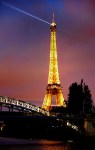
The Eiffel Tower beams a welcome, across the bridge.
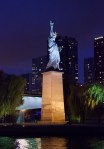
Liberté, Égalité, Fraternité
The City of Light, and liberty.
The Eiffel Tower beams a welcome, across the bridge.
View across the tarmak from terminal 2F-Charles de Gaulle is a beautiful airport.






















































 They're Calling To Me