Category Archives: Mostly True Stories

Words only tell part of the story.

Searching for the Spirit of Christmas

Temple Square Reflecting Pool
The reflecting pool on Temple Square tells the story of Christmas in twinkling lights.

“I will honour Christmas in my heart, and try to keep it all the year. I will live in the Past, the Present, and the Future. The Spirits of all Three shall strive within me. I will not shut out the lessons that they teach!”
― Charles DickensA Christmas Carol

This past year I have been in nearly 30 countries. I have stood on every continent (except Antarctica–maybe next year :). I have been away from home more than I like, more than I should. I have been running as fast as I can, working as hard as I am able. I have had some marvelous, even miraculous experiences. Yet, I would choose to stay home, surrounded by family and friends.

Christmas Lights on Temple Square
Surrounded by thousands of twinkling Christmas lights, the Salt Lake Temple stands as a symbol of faith and hope to more than 15 million Latter-day Saints (Mormons) across the world.

And so it was that our family gathered for Thanksgiving. It was a joyous experience to be with those whom I know love me. The day after Thanksgiving, we all went to Salt Lake City to see the Christmas Lights on Temple Square. As is typical when our family gathers, we were in a hurry. It was cold. We ran through Temple Square trying not to lose each other, trying not to knock anyone over, trying not to lose the Grandparents who wanted to keep up but who kept stopping to enjoy the sights. I barely had time to pull out my camera.

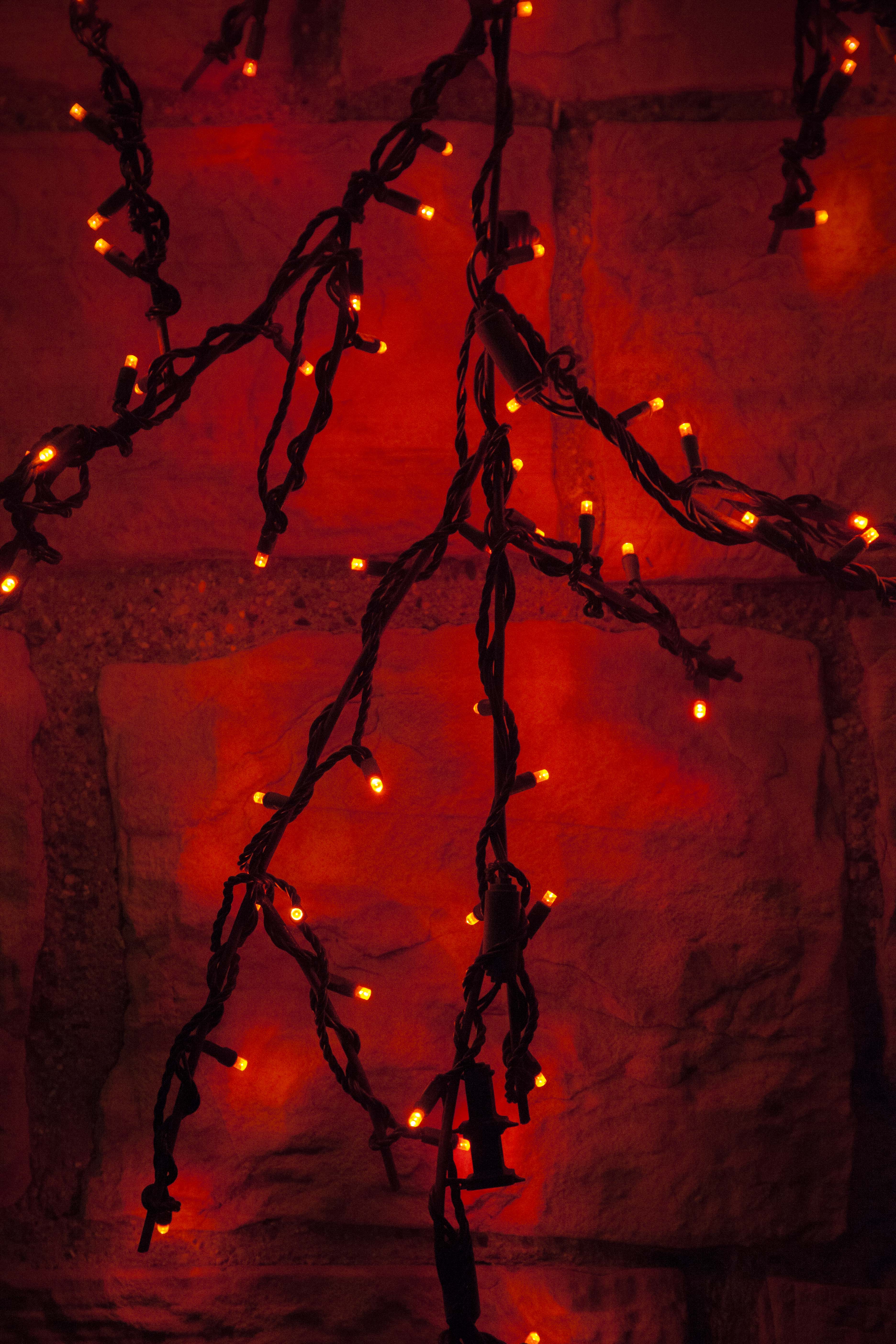
The Color of Christmas
Red, a color of Christmas, lights for the Star of Bethlehem, stone for the Rock of Salvation.

After getting separated, and reconnecting (thanks to cell phones), we ended up at my son and daughter-in-laws apartment drinking egg nog and playing “Apples to Apples.” It was fun, and exhausting, in a good way.

When we returned home, I realized, again, that the joy of Christmas is in keeping it in our hearts and our homes.  I do believe there is a gift, given freely by him, whom we celebrate, that lights our homes, our hearts and our minds, even in the darkest of times.

“And it was always said of him, that he knew how to keep Christmas well, if any man alive possessed the knowledge. May that be truly said of us, and all of us! And so, as Tiny Tim observed, God bless Us, Every One!”
― Charles DickensA Christmas Carol

Star of Bethlehem
Soaring above Temple Square, a star shaped display points across time to the Babe of Bethlehem, born in a manger.

Is Apartheid Over?

Township Housing
Corregated metal, cardboard, canvas and the ever-present barbed wire makeup the materials of most houses in the township.

“What was it like,” I asked him, “apartheid?”

Joseph. Our driver. He was a large, jolly man in his fifties. He had dark chocolate skin with curly, salt and pepper hair. He looked at me and the smile lines around his eyes wrinkled.

He laughed.

Next Generation
Without education, children growing up in the township face limited opportunities.

Not just a chuckle. Joseph burst into a full belly laugh. He had lived through it.  He was 33 when Apartheid ended.

“You would not believe me if I told you,” Joseph said. “My children do not believe me when I tell them.”

At first, I didn’t understand why he was laughing. I didn’t understand how he could laugh. It wasn’t funny.

“Tell me.”

“No.”

I pressed him.

“It was horrible. No freedom. No jobs. We had no hope.”

Community Water Tap
In the Township, 3000 people share three water taps.

He drove us to a township just outside of Johannesburg.

“Three-thousand people live here,” he said. “They have no running water. They have no electricity. They share three water taps. They share 20 portable toilets.”

He introduced me to the people. They were quick to smile, but their eyes were guarded, skeptical. I couldn’t understand their words.  Joseph translated.

Who is this white face with a camera?

Community Portapotty
With no running water or sanitation, 3000 people share 20 portapotties throughout the township.

Why does he take our picture?

Joseph told them I was there to tell their story. I was. They were glad. They were friendly. They wanted me to understand. They wanted others to know of their struggle. For them, Apartheid was not over.

I was stunned. They had so little.

“Why?”

Mother and Child
Child rearing falls to the women. The traditional wrap makes an excellent baby backpack.

“Get in the car.” Joseph said it was time to go. It was no longer safe.

I got in the car.

Joseph did not laugh.

“Apartheid ended in 1994. Those were difficult times. I lost my best friend to a gunshot. I cannot describe…I will not describe those days. We did not know if we would live or die. We had no hope.”

“But, Apartheid has been over for 27 years.”

“These people believe the government will take care of them. They think the government will educate them.”

“Will they?”

Joseph laughed. “They say apartheid is over. It is not. But at least now we have hope.”

The Long Walk Home

On The Path

School was out.  I would meet him on the path.

Halfway.

I could see him, standing there.  He didn’t have far to go.

I waved.  He didn’t.

“Come on,” I shouted.


He didn’t move.

I could see his face, from a distance.

“What’s wrong?”

Then I heard it growl.  Behind a tree.  It barked.

I walked faster.

It barked again.  Advancing.

I could see it.

The dog was small. To me. I smiled, not realizing I had been holding my breath.

It posed no threat.

But he was small, too. So small. To him, the dog was big. Huge. Terrible. Mean.

I stopped.

The menace was between us.  He would not pass.

He looked at me for help and shuddered.  I could see his eyes well up.  The sob was uncontrollable, involuntary.

“It’s just a puppy,” I said.  “He won’t bite.  You can make it.”

He didn’t know that.  He wasn’t sure.  To him the threat was real.

Sharp teeth, bared.

I closed the gap.  I challenged the foe.  I vanquished the demon.

He held my hand as we walked home. His little body shook with sobs he tried to hide.  We didn’t speak.

That night, with some time and distance, he told me about the monster.  It blocked his way.  It threatened his life.  It captured him and wouldn’t let him go.  It was too big, too scary.

I saved his life. He said.

I laughed and held him on my lap. I sang a song to help him sleep and went to bed.

I dreamed.

The way was dark.  The threat was real.  I could not pass.  I felt the violent sob shake my soul.

You can make it.  I heard him say.

I wasn’t sure.  I didn’t know.  I couldn’t see the way.

In the dark I reached out.

He took my hand and we went on.

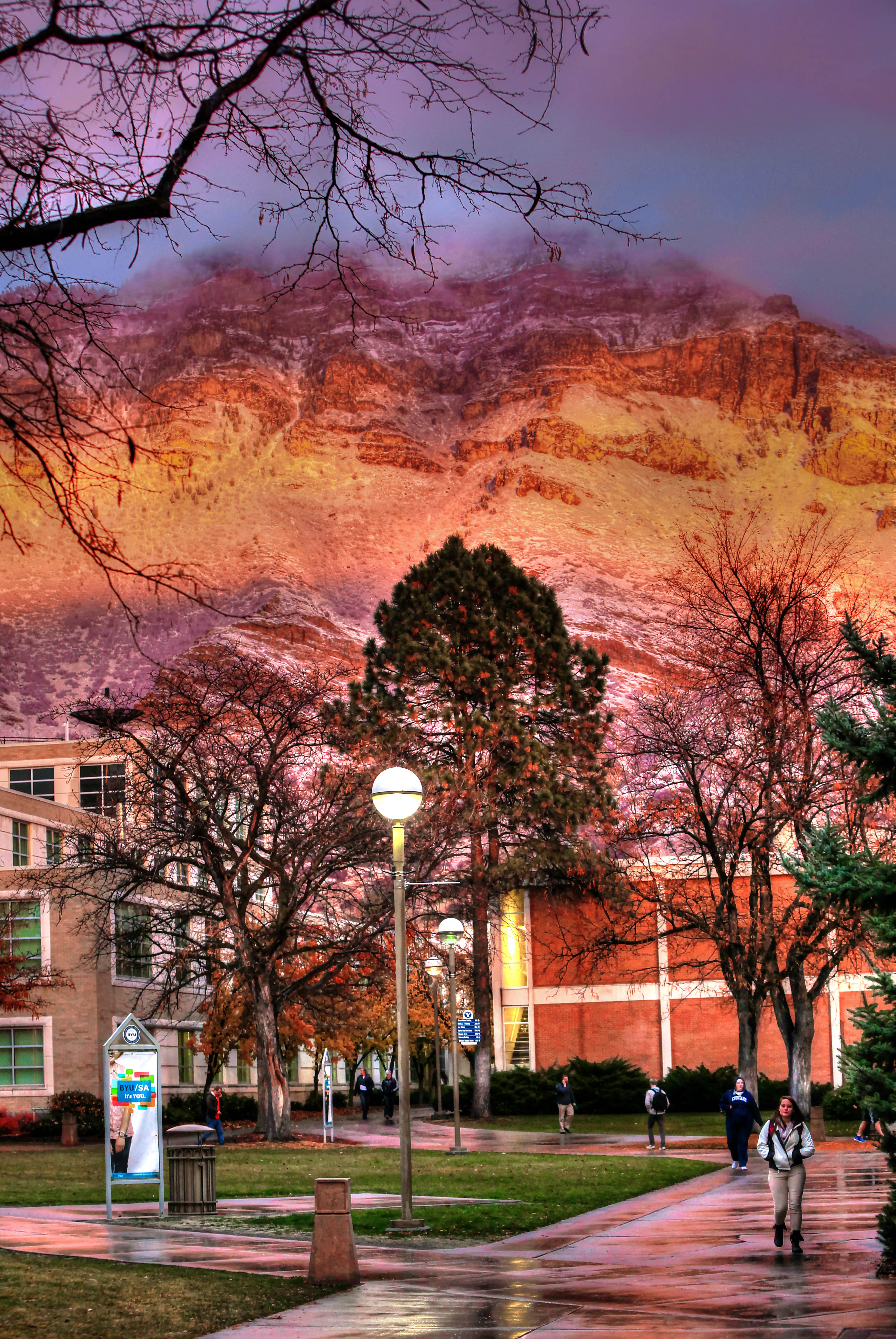
Sunset on Campus

A few nights ago, we were just wrapping a shoot on the campus of Brigham Young University. It had been raining in the valley most of the afternoon and snow had been falling in the higher elevations. Just before the sun set, it dropped below the storm and lit up the mountain. I had just come out of one of the buildings to this scene. I wished I had a better vantage point, a better view. I find, often, that the challenge is not to find a better view, but to see the world where I am in interesting ways. The light changed, the sun dropped below the horizon, it’s brilliance faded. Yet, in that moment I marveled at the beauty. Fortunately I had the presence of mind to take a picture, for the light didn’t last.

Sunset on Campus
The storm was coming. It had been raining. Just before the sun set, it dropped below the clouds and lit up the mountain.

La Ville Lumiére: but first you have to get there

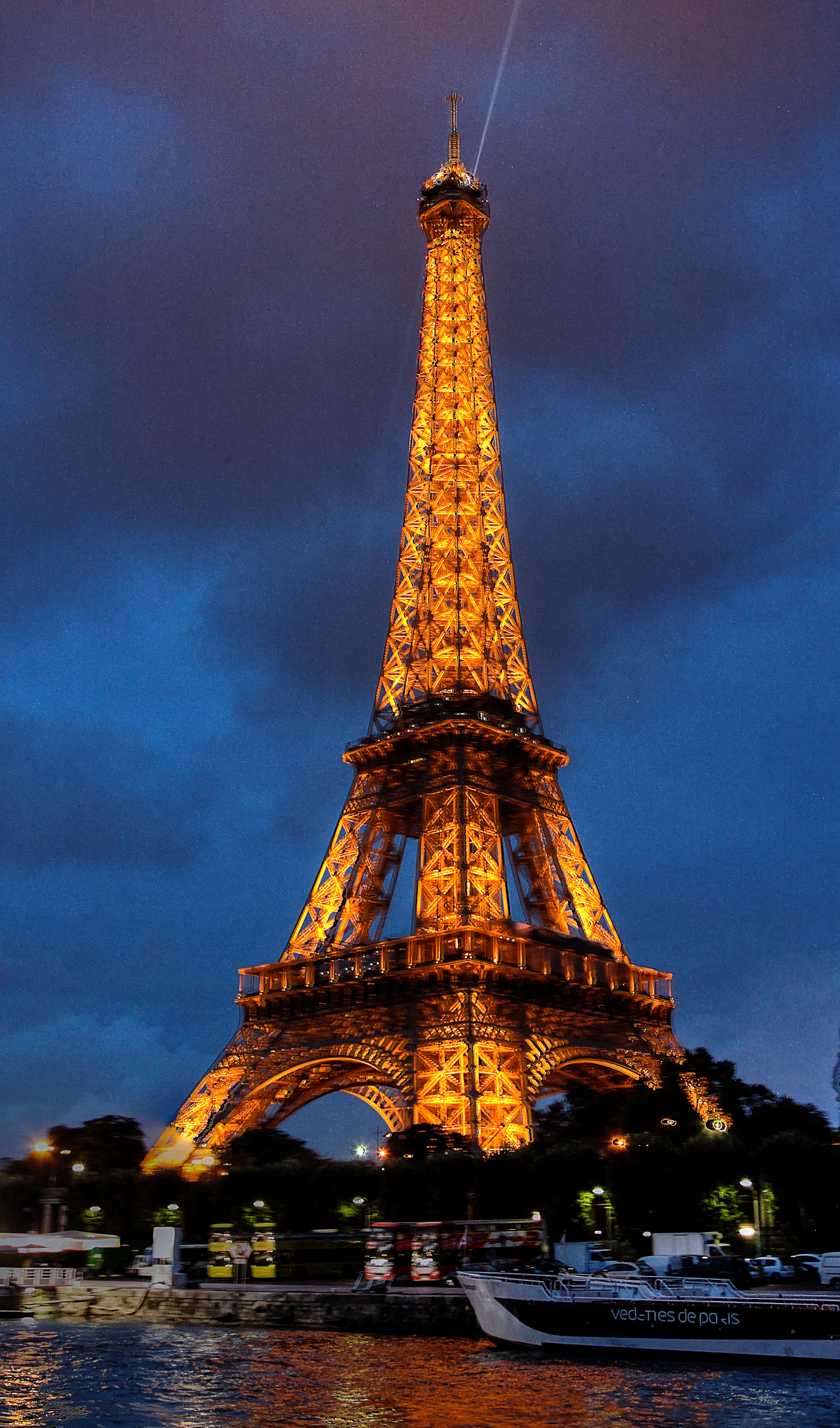
Eiffel TowerThe good news–Tom and I were going to Paris for a documentary film shoot.  The bad news–we only had one day in the city for B-roll. Fortunately, our contacts in Paris agreed to provide a driver who would take us wherever we wanted to go.

Great! We’ll meet him at the airport.

We arrived in Paris early in the morning. Our flight from England had been bumpy and a steady rain was falling in the city. In spite of the early hour, Charles De Gaulle airport was crowded. I’d been to Paris before and knew what to expect.  Pushy people. Cranky travelers. Still true.

Charles de Gaulle AirportWe retrieved our gear and made our way toward the exit, passing the line of people holding signs. I didn’t see my name. We came to the end of the row.  No sign. No driver. Finding a spot for our carts, I made a call.

“Pierre, where are you?”

“I am here.”

“Where?”

“Here.”

“So are we.”

“This is good.”

I don’t speak French.  Pierre spoke English, but I had the impression that complex concepts were not part of his capabilities.

“How do we find you?”

“Do not worry. I will find you.”

Really? How? The call ended before I could ask. Tom looked at me skeptically. He had listened in on the conversation. He decided to swim against the current and take another pass at the sign holders.

“No luck?”

“Nada.”

“I didn’t know you speak Spanish.”

“I don’t.”

“Bonjour mes frères.”

True to his promise, Pierre stood before us, holding a sign with our names on it. His smile was encouraging.

“Bonjour,” we said. “How did you find us?”

“This way,” Pierre said, ignoring our question and stepping into the stream of transient people.

“How did he find us?” Tom asked me. I shrugged, following Pierre’s example and pushing my cart into the stream.

As we made our way through the airport, I noticed that Pierre was older than he sounded on the phone. He had a shuffle-step limp and didn’t seem to see particularly well. When the crowds thinned out and I could walk beside him, Pierre assured me he could drive us anywhere we wanted.

“Perfecto,” I said, not really sure which language, if any, that was.
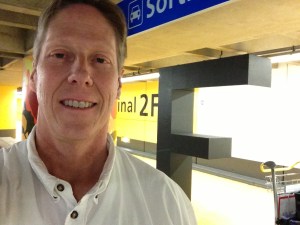
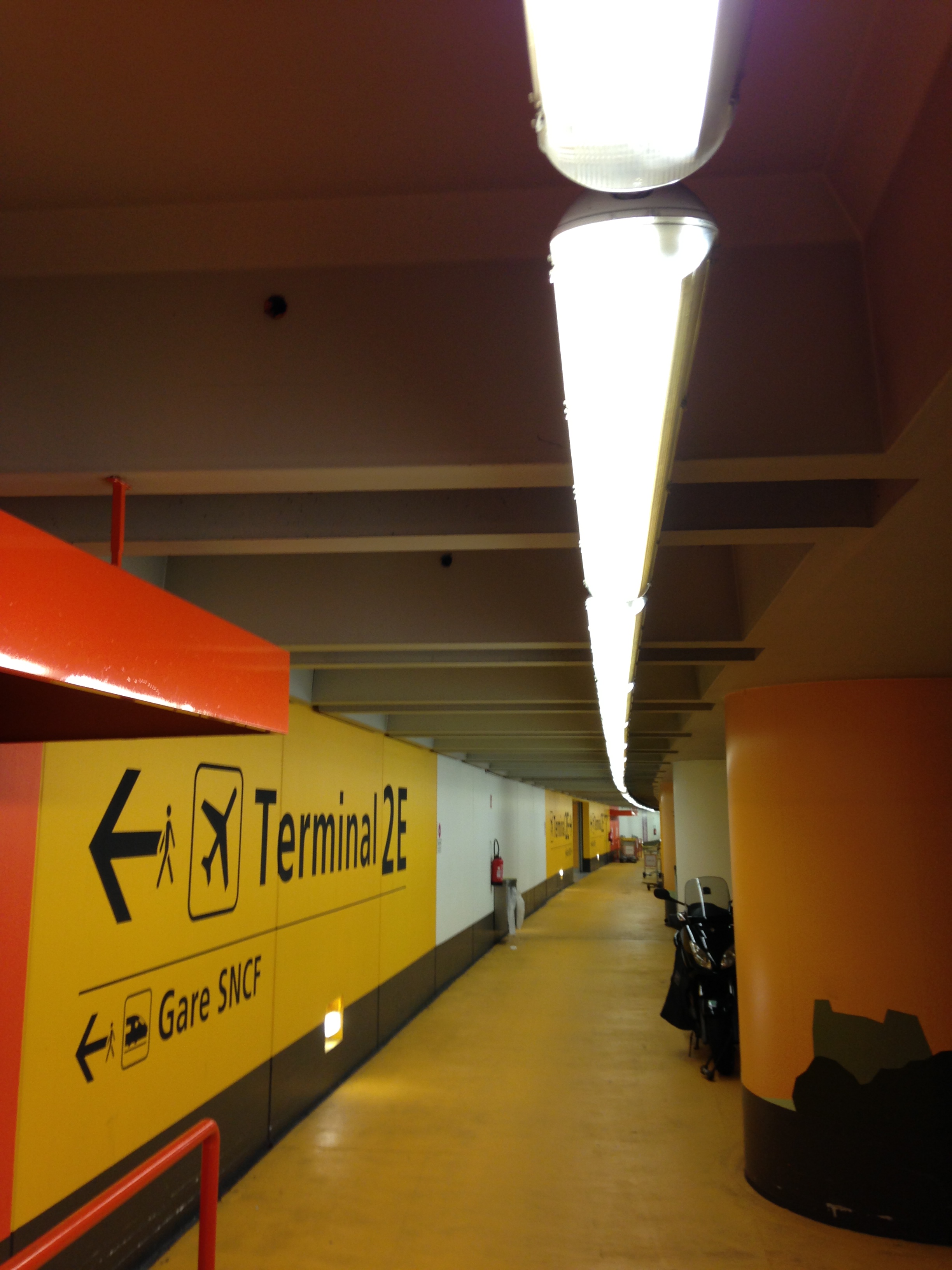
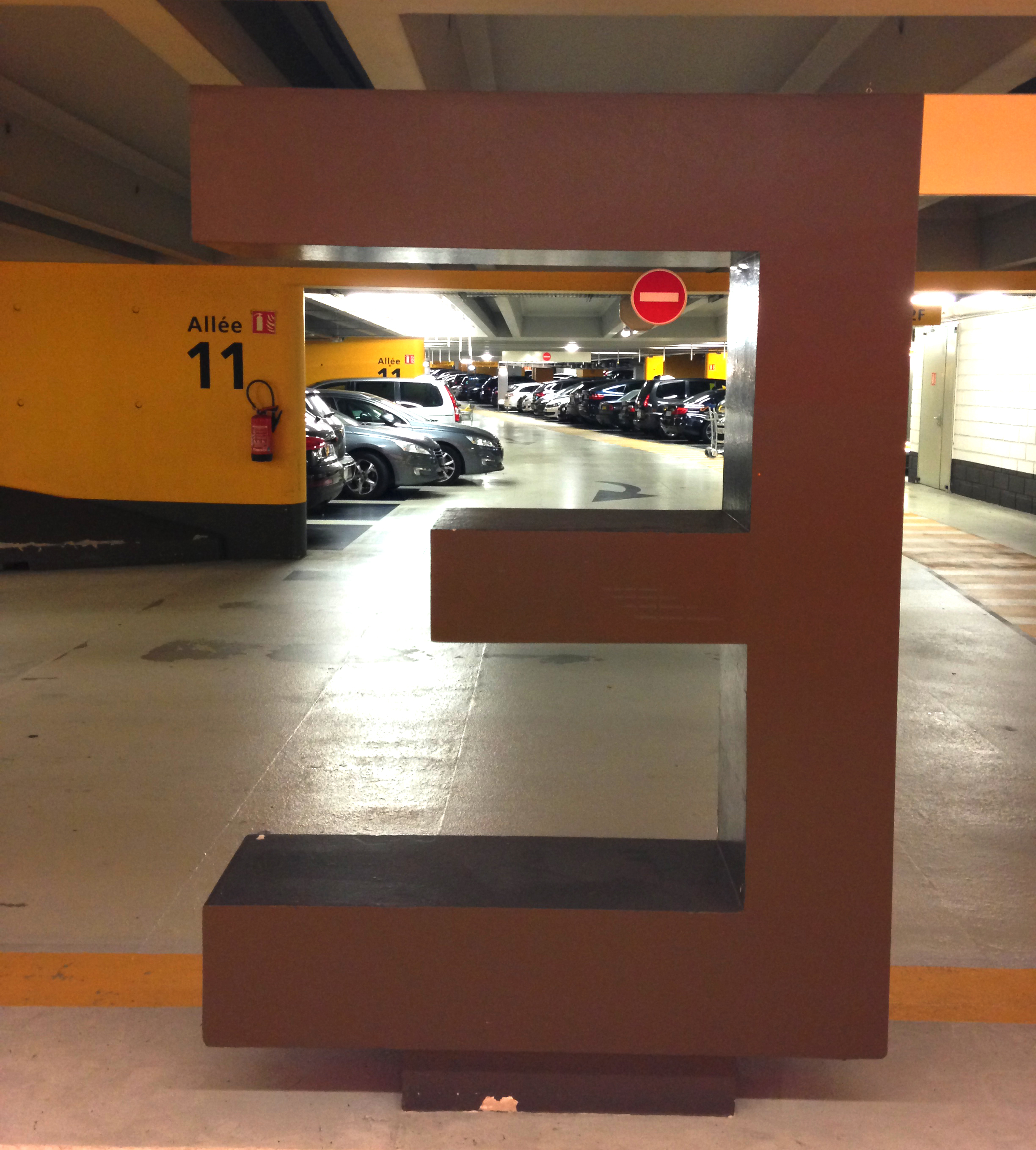
Parking terminal 2FOur carts piled high with equipment, Tom and I forded the river of humanity-in-transit as Pierre lead us to parking level minus-2F.  We followed him, slowly, through the underground depths to row eleven, space twenty-six.  Pierre stopped abruptly and stared at the car in space twenty-six.  Tom and I stared at Pierre, staring at the car in space twenty-six.

“Pierre, I don’t think this car is going to work,” I said, as the truly Parisian mini-smart car waited proudly before us.

“No,” Pierre said.  “This car will not work.”

Tom and I looked at each other, not sure if this realization was just dawning on him or if Pierre had known this when he rented the car.

“Pierre, can we exchange it?”

“No,” he said with his strong French accent.

“No?” we repeated.

“No!” he repeated.

“Pierre, this car won’t do.”

“This is not my car.”

“Not your car?”

“No.” Pierre said.

Tom and I looked at each other again, relieved.

“Okay.  Where’s your car?”

“I don’t know.”

“You don’t know?” We had picked up the habit of repeating everything Pierre said.  It was comforting but not really clarifying.

“No.” Pierre continued to stare at the smart car. “This is where I parked.”

Now what?

Pierre began to shuffle down the row of cars. “Sometimes I have memory problems,” I think I heard him say—not sure—he was facing away from me—maybe I just imagined he said it.

“What kind of car is it?” I asked.

“Use the clicker,” Tom suggested.

Pierre didn’t answer.  He just got further away.

“I’ll help him,” Tom said, abandoning his cart and racing down the opposite row of cars.

Charles de Gaulle parking 2EIn moments, Pierre and Tom had disappeared from view and I was left alone with two carts of equipment.  The air in the parking garage was stale, carbon monoxide mixed with French tobacco.  The temperature seemed to be rising.  The ceiling seemed to be getting lower. The lights were growing dim… I sat down on my baggáge to wait.

Charles de Gaulle airport is big.  Really big. So is the parking structure. Pierre and Tom appeared and disappeared at regular intervals, emerging and submerging into and out of the bulkhead dividing rows.  This was comforting and disconcerting, for awhile. Then they were gone. For a long time.

When he eventually did return, Pierre assured me he had parked in one of the rows.

“Good to know,” I said, trying not to be cynical. “Which one?”

“It should be here,” Pierre said.

I could only agree, both of us shrugging as if the car had moved by itself.

Tom finally returned, breathing hard.  He had jogged the entire length of the section.

“Volkswagen,” Tom said. Pierre had remembered somewhere down one of the rows.

“Any luck?” I said.

“No,” Tom said matching Pierre’s accent.

After one hour of searching for the car, using the clicker, we began to think maybe someone had stolen it.  However, Pierre assured us that was not the case. He gave me the impression that Paris was without thievery of any kind.

“Have faith,” he said.

What else could we do? There was only so much daylight available.  So, we kept looking—faith and prayer tinged with a hint of desperation.

Charles de Gaulle parking section 2EAfter two-and-a-half hours, in a different terminal, we found the car.

“Voíla. Right were I left it,” Pierre said, smiling sincerely.

“Voíla,” I said. My French accent was not as good as Tom’s.

As we got in the car, Pierre asked, “Would you drive?  I don’t know how to drive a stick shift.”

Tom and I looked at each other, uncertain now how Pierre had actually parked the car.  “Sure,” I said, “Let’s go see Paris.”

“I will show you,” Pierre said.

Sometimes you just have to bend the rules

Leaning Crossing Light.
Bent, not broken in Caracas.

You can buy a gallon of gas for pennies, but a used car costs $150,000. Don’t even think of buying a new car.  It’s a six month wait in Caracas, Venezuela.

The national exchange rate is 6 Bolívares for every 1 US dollar.  Yet, on the black market street exchange, with a little help from friends, you can get 28 Bolívares for every US dollar.  There is a shortage of dollars and everybody wants them.

Hugo Chávez was President of Venezuela from 1999 until his death on March 5, 2013. During his Presidency, Chávez nationalized key industries, increased government funding of healthcare and education and attempted to reduce poverty through oil revenues. Many Venezuelans loved him. Many Venezuelans didn’t.

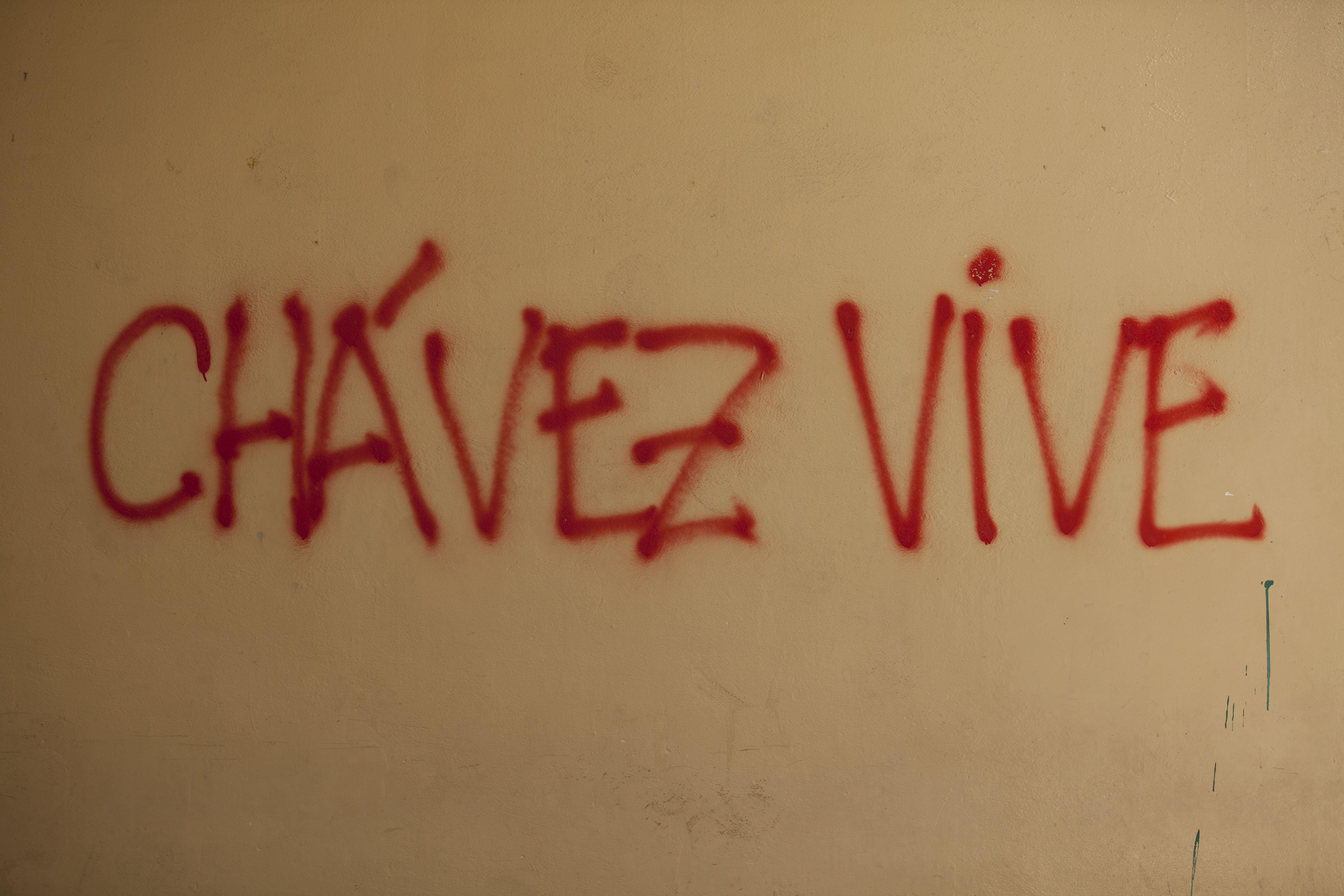
Chávez Vive
Graphiti expresses a nationalized hope for miracles.

As a NorteAmericano, I have found Caracas to be a study in contrasts. The people love Chávez. They want him back. He’s dead, contrary to popular opinion.

Traffic, pollution, poverty and overcrowding are visible everywhere, juxtaposed against the towering high rises and upscale shopping malls of downtown Caracas. Crime is rampant. If you’re not Venezuelan, there are places you just don’t go. Period.

During my stay here in Caracas, I met some interesting and friendly people. They taught me early on to only cross the street when the cars weren’t coming, regardless of the color of the traffic light. I will keep these friends. Their skin color and nationality do not matter to me.

During my stay in Caracas, I also spent a fair amount of Bolívares. Yet, if I can change my money back at the nationalized artificial rate, I may take home more than I started with. When it comes to the friends I have made, there is no question about it, I am much richer now for having crossed the distance between countries.  I hope to cross again, regardless of the traffic signals.  In Venezuela, sometimes you just have to bend the rules.