The air was dry–bone-dust drifting on a desert draft. A storm was coming, you just couldn’t see it yet.
I could hear an engine–distant but closing. The angry sound broke a stillness the desert was reluctant to give up.
Arizona highway? Just a dirt road in the desert.
A Border Patrol agent looked like he was cruising main on Saturday night, one hand on the wheel and one arm out the window–low and slow, The mud caked SUV stopped rolling and a red dust cloud wafted across the sun.
“What you boys doin’ out here?”
Grit ground in my teeth and I spat. “Taking pictures.” I held up my camera.
“Nice night for it,” he said. The sun was setting, but it wasn’t night yet. “Best be careful.”
The way he said it, I wondered if I should call my attorney. I nodded, not agreeing, just nodding.
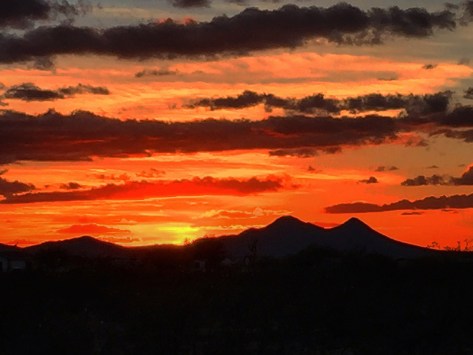
Arizona sunset near Marana, Arizona.
“Ghosts,” he said, shaking his head like I knew what he was talking about, “don’t leave no tracks.” He looked down at the dirt and I couldn’t see his eyes. “They like to cross the border after dark.”
He continued to study the sandy ground for a long moment. Then he looked up. Our eyes met.
“Watch yourselves,” he said.
A coyote howled in the distance.
“Ghosts,” he said again. He tipped his hat and the SUV lurched forward. Tire tracks appeared where tires used to be and a new dust cloud buried their trail.
As the SUV disappeared into the desert, the sun touched a mountain and set the sky on fire. Quiet fell on falling dust.
Sunset near Marana, Arizona.
My friend came out of the brush with his camera and tripod.
“What was that about?”
I thought I knew, but I wasn’t sure. I could hear movement in the brush. Footsteps, maybe.
“Ghosts.” I Pressed the cable release on my camera. The mirror popped up and the shutter opened. The sound was louder than I remembered. “They like to cross the border after dark.”
Lightning flashed on the horizon. The sound of a distant jet called from above. The coyote howled again.
A crescent moon rises after sunset over the Arizona desert.
We stayed there taking pictures until long after the light was gone.
Desert grasses and rock monuments catch the late afternoon in the Arizona desert not far from the Salt River.
The painted Arizona desert.
Arizona sunset near Marana, Arizona.
A crescent moon rises after sunset over the Arizona desert.
The sun sets over a cilantro farm on the Pima-Maricopa reservation.
Evening breezes waft the aromatic scents of cilantro across the valley as the sunsets on the Pima-Maricopa reservation.
Arizona highway? Jost a dirt road in the desert.
Painted mountain sunset in the Arizona desert near Marana.
Saguaro lake on the Salt River, Arizona.
Saguaro lake on the Salt River, Arizona.
A saguaro cactus stands tall in the Arizona desert.
Saguaro cactus populate the painted Arizona desert.
A saguaro cactus stands tall in the Arizona desert.
I lived in New England for two years. My first winter was spent in New Hampshire and Massachusetts, my second winter in Maine. Both winters were brutal. I was cold all the time. Nor’easters or down’easters were common. I survived the blizzard of ’78. One storm was so bad we couldn’t open our apartment door because the snow drifts were too high. We had to climb out the window and dig out the snow so we could open the door. Another time, we lost power for days because the ice storms had stripped the power lines and trees. The damage was horrific. But the world was sparklingly beautiful. It was during this time that I fell in love with the poetry of Robert Frost. His words evoke imagery and meaning with powerful poetic device which transcends place.
I no longer live in the east. Yet the seemingly simple home spun lessons of the New England poet stay with me. The words resonate in my western surroundings in spite of their New England sensibilities. Frost’s poetic imagery transcends time and place. The inspiration I found in the New England woods is also to be found in the Wasatch Mountains.
STOPPING BY WOODS ON A SNOWY EVENING
by Robert Frost (an extract)
Whose woods these are I think I know.
His house is in the village though;
He will not see me stopping here
To watch his woods fill up with snow…
…The woods are lovely, dark and deep,
But I have promises to keep,
And miles to go before I sleep,
And miles to go before I sleep.
MENDING WALL
by Robert Frost (an extract)
…He is all pine and I am apple orchard.
My apple trees will never get across
And eat the cones under his pines, I tell him.
He only says, “Good fences make good neighbours”…
I enjoy the four seasons, I really do, especially Vivaldi’s. When it comes to the weather, I like it warm. Hot. Rarely is it ever too hot. I live in Utah. This week, Thanksgiving week, it is supposed to snow. Don’t get me wrong, I like snow. I even like to shovel snow. I just don’t like the cold that comes with the snow. I would enjoy the four seasons more in Aruba, where the average high temperature in November is 86ºƒ and the low temperature is 71ºƒ. Gentle breezes blow all year round and the temperature never varies by more than a few degrees.
I’ve been to Aruba.
I want to go back.
As our family gathers for the holidays, I give thanks for the warmth of home, family, food and abundant blessings. However, as the snow begins to fly, I will turn my electric blanket up and dream of warm Caribbean waters, tropical breezes and the white sands of Aruba. And, I will return, at least in my blog.
Pleasant shade trees abound on Rodgers Beach, Aruba.
The cool sand feels great at sunset in Aruba.
A couple watch the sunset at Palm Beach, Aruba.
A couple stroll along the beach in Aruba.
Anne sitting in a beach chair at Palm Beach, Aruba.
Consistent winds bend Arubian palms trees all year round.
At the southern tip of the island, Baby Beach has a number of pleasant palapas for shade.
Sunset at Palm Beach, Aruba.
The souther tip of Aruba features some deserted but rugged beaches.
A cool drink in the hot sun is never too far away in Aruba.
The sands of time seem to stop while relaxing in Aruba.
Fresh water showers have surfboard style in Aruba.
Come sail away…
Strong surf carves numerous rock bridges on the south shore of Aruba.
A secluded cove makes for a nice place to relax on the south side of the island.
I turned off the engine and got out of my car. The first thing I noticed was the quiet. My footsteps crunched. The sound shattered the quiet so I stopped moving.
Not even a breath of air disturbed the stillness.
Late fall colors behind Mt. Timpanogos.
I strained to hear something, anything. A distant bird cry, found my ears. A hawk floated on invisible air currents above a mountain meadow. It had seen me first. Its screech brought relief. I had not lost my hearing, rather, I had lost the noise of cities and people when I drove beyond the paved road. It would take some time for my brain to adjust to the back country silence.
Heavy footsteps echoed against the mountains, coming closer. A father and son lumbered past, walking a nearby trail with rifles and backpacks. Deer hunters. They were not quiet. The deer would hear them coming.
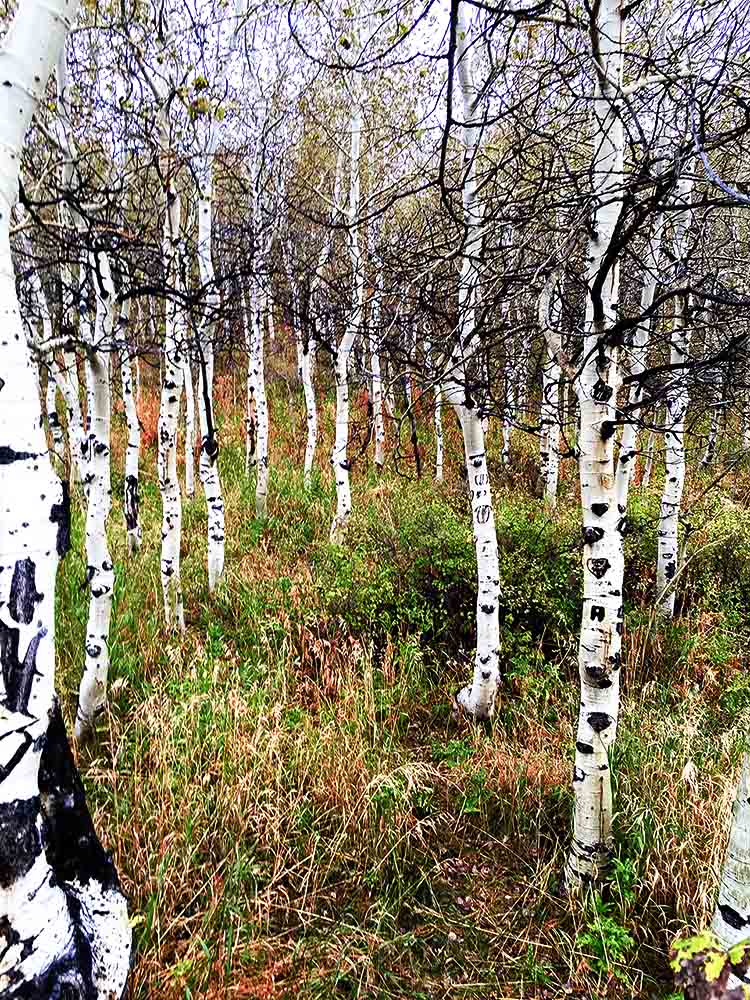
The leaves are mostly gone from this aspen grove behind Mt. Timpanogos, although fall colors remain.
I turned from my overlook and hiked into the Aspens. The stillness of open land evaporated amidst the stand of trees. It was not that it wasn’t quiet. It was more that the trees were aware of my passing and were whispering among themselves. I could hear them, but I could not understand the words. I was not unwelcome, but I was watched.
Fall had come to the high mountains. The calendar did not yet speak of winter, but the nearly barren branches spoke of cold nights and shortened days. Fall colors still glowed beneath the trees, holding on to their end-of-life color. There must be an inherent knowledge in nature that life will come again in order to celebrate death with such brilliance.
Time slows down near a mountain stream in American Fork Canyon.
In the distance I could hear the soughing of water. In a few minutes I found the stream. It wasn’t a big stream but it had been raining and the gentle babble was swelling to a rush. A persistent drizzle suggested more rain was coming. Perhaps the stream had river aspirations.
Rays of light penetrate the clouds just before sunset in American Fork Canyon behind Mount Timpanogos.
I would not stay long in these mountains, this day. My journey was meant only as a reminder of peace and place and permanence in Mother Nature’s cycles.
I would touch the earth to quiet my soul and take with me a portion of stillness.
Deer Creek Overlook, Wasatch Back.
The leaves are mostly gone from this aspen grove behind Mt. Timpanogos, although fall colors remain.
Moss grows rich and thick and green near a small stream in American Fork Canyon.
Berries brightly accent the fall colors of American Fork Canyon.
Berries remain, perhaps as bear food for the coming winter in American Fork Canyon.
Water drops bead on forest floor foliage in American Fork Canyon.
Although many leaves have fallen at high elevations, some fall colors remain along this stream in American Fork Canyon.
Mountain stream in American Fork Canyon.
Slowing time on a mountain stream in American Fork Canyon.
Moss grows on all sides of these woods in American Fork Canyon.
Late fall colors behind Mt. Timpanogos.
Fall colors reamin in an aspen grove near Mt. Timpanogos.
Rays of light penetrate the clouds just before sunset in American Fork Canyon behind Mount Timpanogos.
There are moments in life which transcend expectation, which transcend time. And there are places in life which transcend those moments. Transcendent experience is something to hope for, even, to seek after. Yet, the fleeting nature of transcendence reveals an existential quality of mortality.
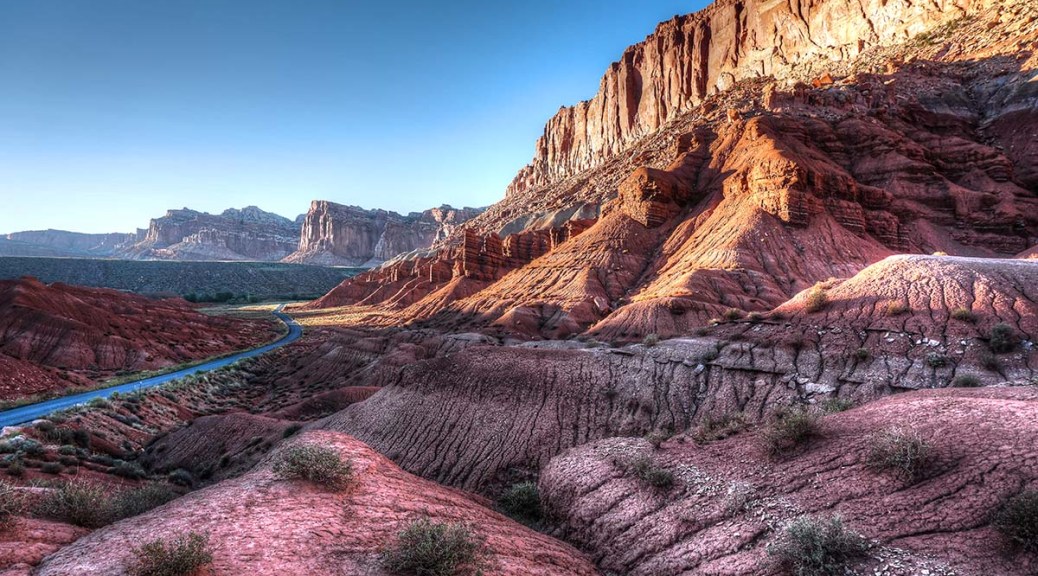
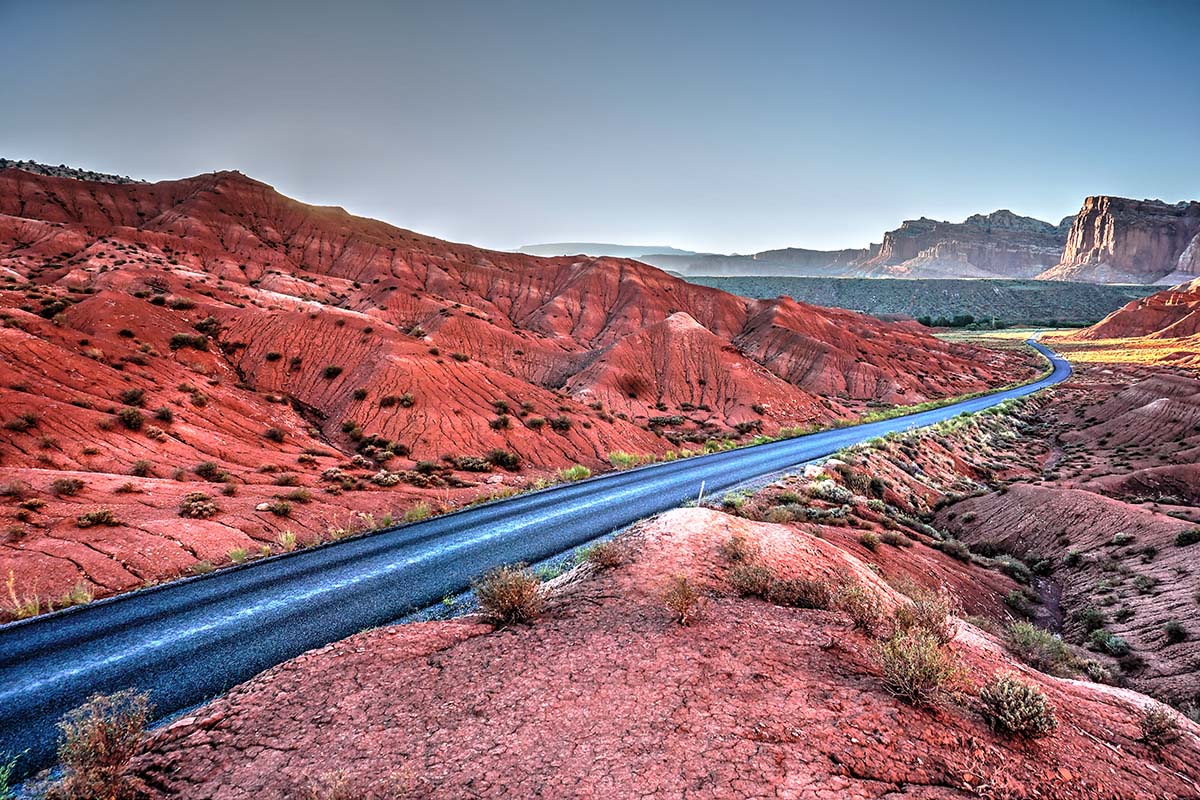
The road through Grand Valley, Capitol Reef.
Transcendence can not be achieved, it can only be experienced. And, the experience of transcendence comes when least expected.
It may be that transcendence is only possible when the imposition of expectation has been removed. Perhaps, in those moments, there is a void which only grace can fill. As grace reveals divinity, divinity reveals truth. Truth transcends the moment and our understanding of existence, who we are, where we come from, what our purpose is, becomes clear, or, if not clear, at least implied. In transcendent moments, inspired questions transform the heart. The sacred nature of transcendent transformation ennobles the soul.
Chimney Rock from a distance, Capitol Reef.
Capitol Reef is such a place–a place of transcendent transformation; transcendent because it exceeds expectation; transformative because it is slowly, yet contagiously transforming.
I have , purposely, waxed philosophic. Indeed, the loftiness of the ideas expressed can not compare to the actual grandeur of visiting Capitol Reef, however briefly I was there. In geologic terms, any time that I could spend there, however long that might be, would be brief. Nevertheless,the time I spent in the park was transcendent.
It is impossible to capture the essence of the place, nevertheless, the majesty of the rocks cried out for something beyond the ordinary. So, forgive, if you will, my HDR sensibilities. While the images presented may lean toward hyper-reality, the actual experience of moments in Capitol Reef transcends the ordinary and claims the extraordinary.
Besides that, it was a lot of fun 🙂
Chimney Rock from a distance, Capitol Reef.
Capitol Reef rock formation on the trail to Hickman Bridge.
Chimney Rock in HDR
Freemont River cut, Capitol Reef National Park.
Davy and Anne at Hickman Bridge, Capitol Reef.
Davy and Anne at Hickman Bridge, Capitol Reef.
The road through Grand Valley, Capitol Reef.
Wind Gate, Capitol Reef.
Chimney Rock, Capitol Reef.
In the distance, Capitol Dome rises above the sentinels of Capitol Reef.
Wide shot of Capitol Reef rock formation on the trail to Hickman Bridge.
It takes a while for things to change.
Patience and faith, they say.
I can’t wait. I won’t, I say.
You must.
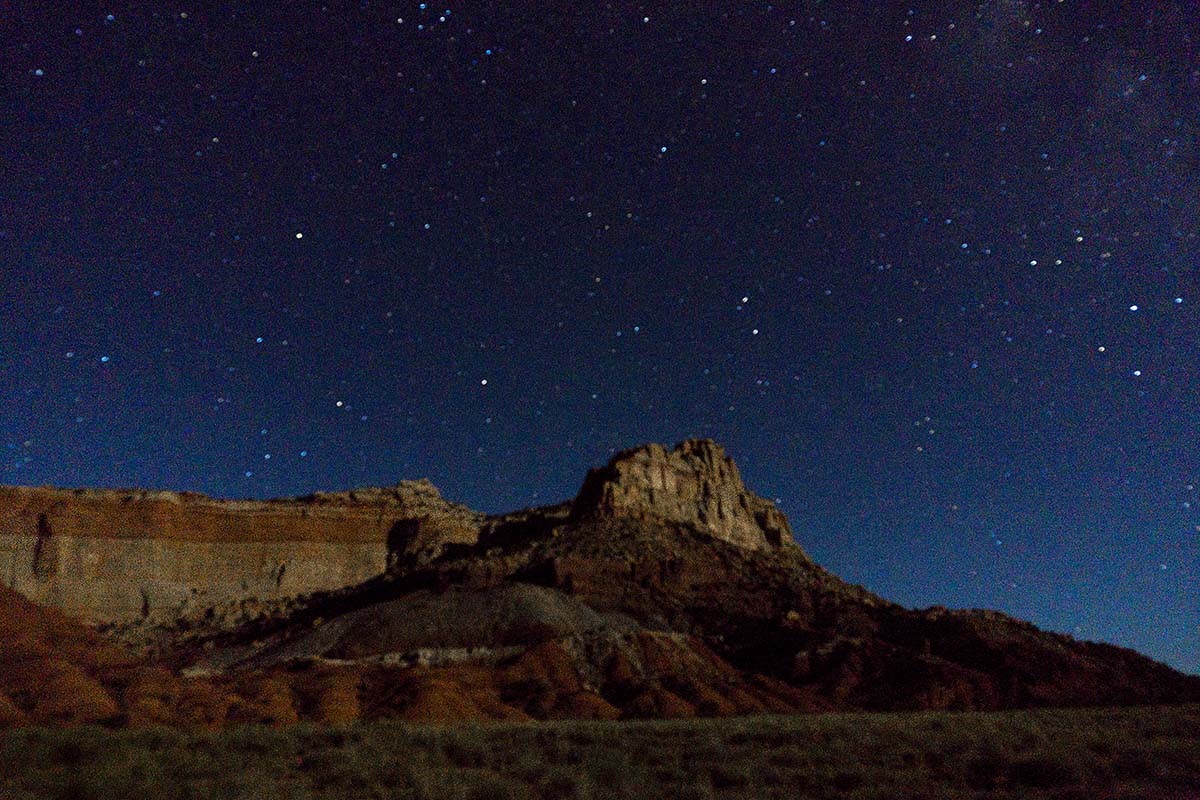
Stars above Grand Wash Capitol Reef.
Deep time puts the age of Earth at four-and-one-half billion years.
Named after Joseph Hickman, Hickman natural bridge is 133 feet long and 125 feet high.
I sense immense distance in Earth’s span, yet the years mean nothing in comprehending the patterns of death and life and death again which deposit layers of yesterdays upon tomorrows, until all that remains is this moment.
I stand in a place where the evidence of change surrounds me, yet actual change can not be seen.
Perhaps these rocks crumble to dirt,
waiting,
for a million, maybe a billion years, for me to walk this path.
Red dirt sticks to my shoes and I carry it with me in defiance of the law of long waits.
The Freemont river cuts a valley just below Capitol Dome.
I am here. Now.
The wind soughs and the rocks speak in whispers. I stand still and listen. The words do not bring me comfort. Change is as the rocks.
Capitol Dome, Capitol Reef National Park.
I look up at the sandstone sentinels and the sky stretches out before me.
I am small, insignificant, tenuous.
I look down and a silver stream glints below towering canyon walls. My heart skips a beat and I step back from the ledge. I have climbed much higher than I realize.
Davy scales the cliffs near Hickman Bridge bowl.
My breath catches as my son scales the cliffs below me. The rocks he climbs are hard broken. I call out not to walk those rocks, they may crumble. He has not yet reached the precipice on which I stand and must choose his path. I squint in harsh sunlight and see myself in his approaching shadow.
I feel old.
I see in him that I am old,
old in that my body is not what it once was;
not so old, in that the elements which make up my frame have not yet been scattered by hot winds relentlessly carving through stone.
My son will climb much higher than I have steps remaining. Yet, I still have steps remaining.
And the Gods said, “Let it be so.” And they watched those things which they had ordered until they obeyed. For even the Gods must watch and wait.
The Big Dipper rises above Grand Wash Wind Gate in Capitol Reef.
In the vast continuum of eternity, patience and faith take time.
So I am learning.
Towering sentinels of Capitol Reef.
Wistfully, I lift a handful of dust and toss it to the sky. The wind accepts my offering.
My time has come. I have touched the rock of ages and must not linger.
In deep time,
the changes I hope for are carving the canyons of my soul.
Capitol Reef National Park.
Looking up at Hickman Bridge.
Red dirt gives way to azure skies.
Worn ragged by the forces of nature, this rock came to rest at the bottom of a cliff as a wrecked ship rests on the sea bottom.
Among the aging sandstone some forms of live thrive, others pass out of existence.
Towering sentinels of Capitol Reef.
Evidence indicates that in a flash flood, Grand Wash is not the place to be.
Very little water and harsh conditions favor plants which learn to adapt.
Davy scales the cliffs near Hickman Bridge bowl.
Morning sun rises over Hickman Bridge.
Named after Joseph Hickman, Hickman natural bridge is 133 feet long and 125 feet high.
Weather sandstone makes for interesting trail markers on the Hickman Bridge trail in Capitol Reef.
The Freemont river cuts a valley just below Capitol Dome.
Anne and Davy stand below 125 foot high Hickman Bridge.
Capitol Dome, Capitol Reef National Park.
Red dirt still glows just after sunset in Capitol Reef National Park.
Moon sets over Capitol Reef National Park.
The Big Dipper rises above Grand Wash Wind Gate in Capitol Reef.
Stars above Grand Wash Capitol Reef.
View of Chimney Rock Capitol Reef.
Capitol Reef National Park.
Verdant valleys contrast the sandstone cliffs of Capitol Reef National Park.
Trees provide welcome shade at the Fuita Campground in Capitol Reef National Park.
Apple orchards thrive in the valleys of Capitol Reef National Park.
Apple orchards thrive in the valleys of Capitol Reef.
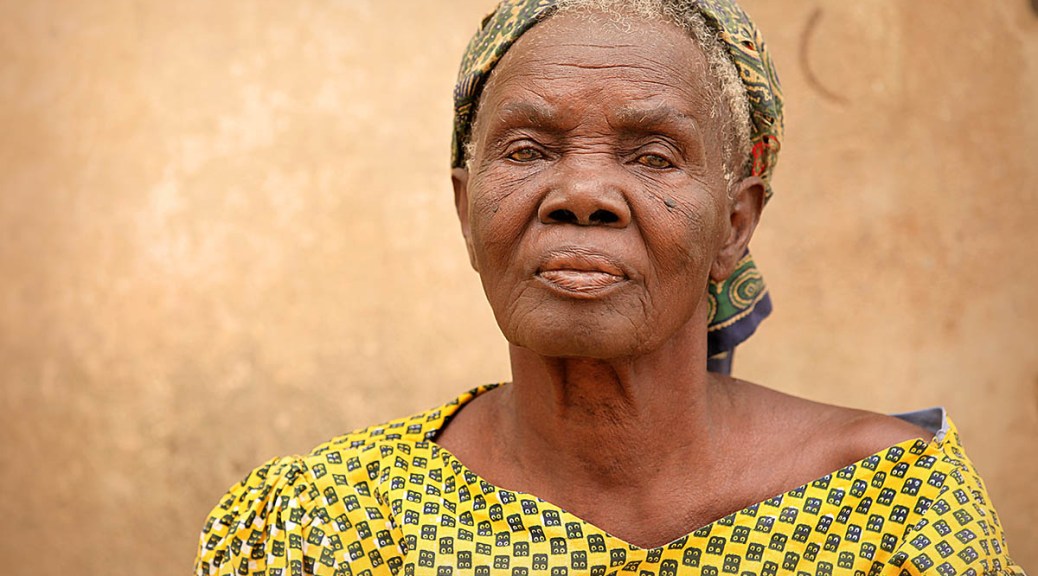
Though she is old, she leads–perhaps because she is old.
Three hours from Accra and the roads got really rough. We had been driving into the bush and each mile seemed to take a millennium. The more we drove, the farther back in time we went. As we drove into the village of Yamoransah, young girls stared at us as they mashed roots for food. Young children surrounded us, posing for our cameras. The village Matriarch watched our approach, proudly. She did not speak English. There was no need. This was her village.
As we approached, she slowly rose and the children quieted. She did not need her walking stick for authority. Her voice was soft and quiet, yet the young mothers gathered their children and went inside.
Somewhere, in the delicate balance of past and present, she kept her village safe. The old ways still worked, although her eyes were growing dim.
Teenagers charged their cell phones at a generator near the village well.
For more info on my show check out a June 11th article in The Spectrum.
It can be painful when a pilgrimage is not all it was supposed to be.
Tired, alone and far from home, the Eternal City, can be an unforgiving place. Religious tradition may favor the Catholics in Rome, yet Islam entertains apocryphal hope for ultimate victory in the struggle for religious domination. Global politics and religious ideology lose their import when you are sick and hungry. With no place left to go, a bridge over the Tiber River is as good a place as any to end a pilgrimage.
For more info on my show check out a June 11th article in The Spectrum.
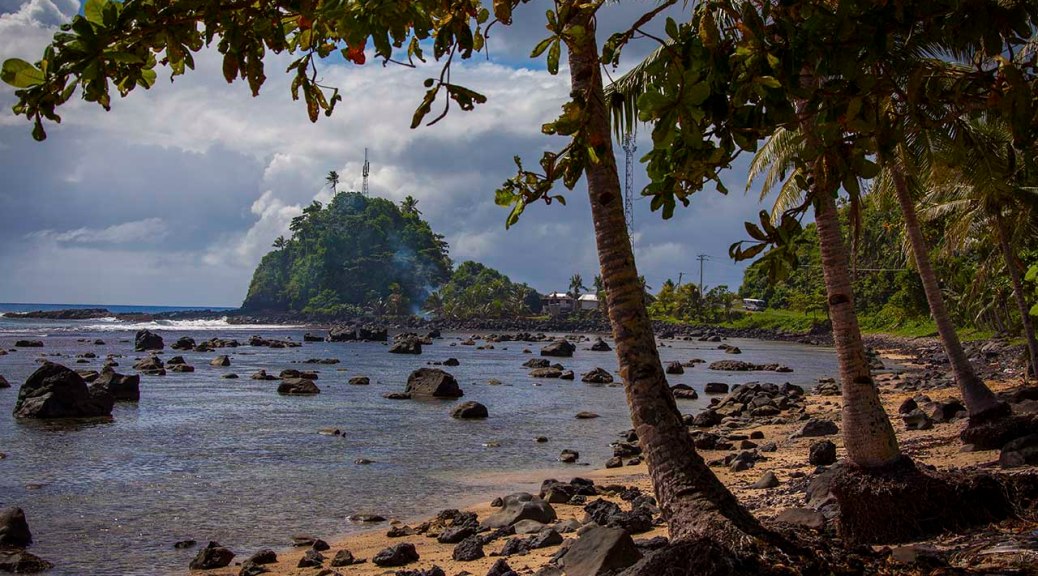
A calm before the storm settles over the bay on Upolu, Samoa.
The air was heavy, oppressive. Dark clouds rose above a steel horizon. The humid air made it hard to breathe. I took a shower that morning, but never dried off, still dripping. The clear ocean called to me, but a storm was coming. I could feel it in the quiet slowness. No one was in the water. Most of the locals were resting on mats in their fales. A Samoan home, or fale, is mostly built with bamboo and thatch, allowing maximum airflow. The air was not moving.
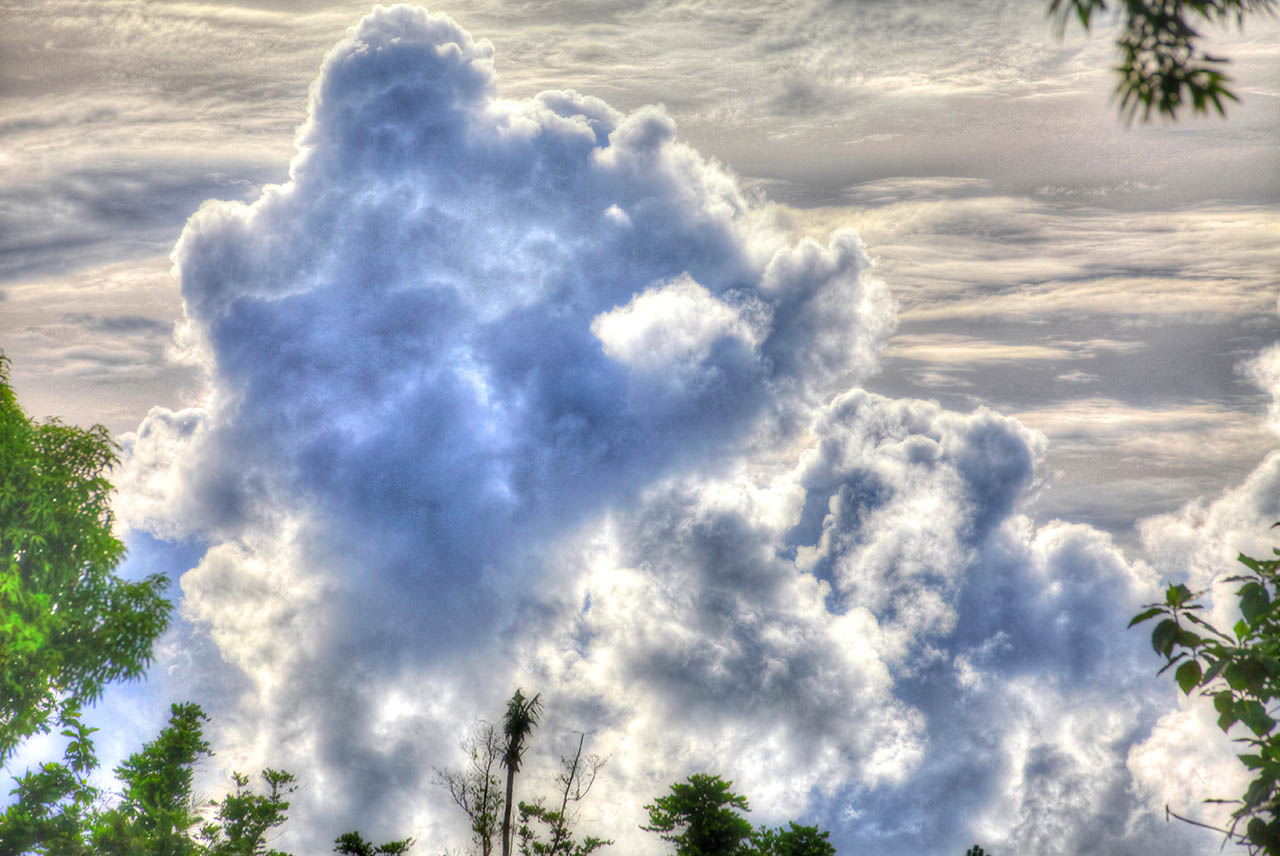
Storm clouds bloom over Upolu Island, Samoa.
I watched them come, the dark clouds. The weight of wet-hot weather pushing, pushing down on my chest, holding me in place as I watched them grow, the clouds. I wanted to lie down and not move, sleep until the dark dream dispersed.
When the rains came, it was sudden, as if the ocean moved onshore. The sky was water. The air was liquid. The drops were waves, crashing to earth. The sound rose and swelled, drowning all other sounds.
Then, quiet.
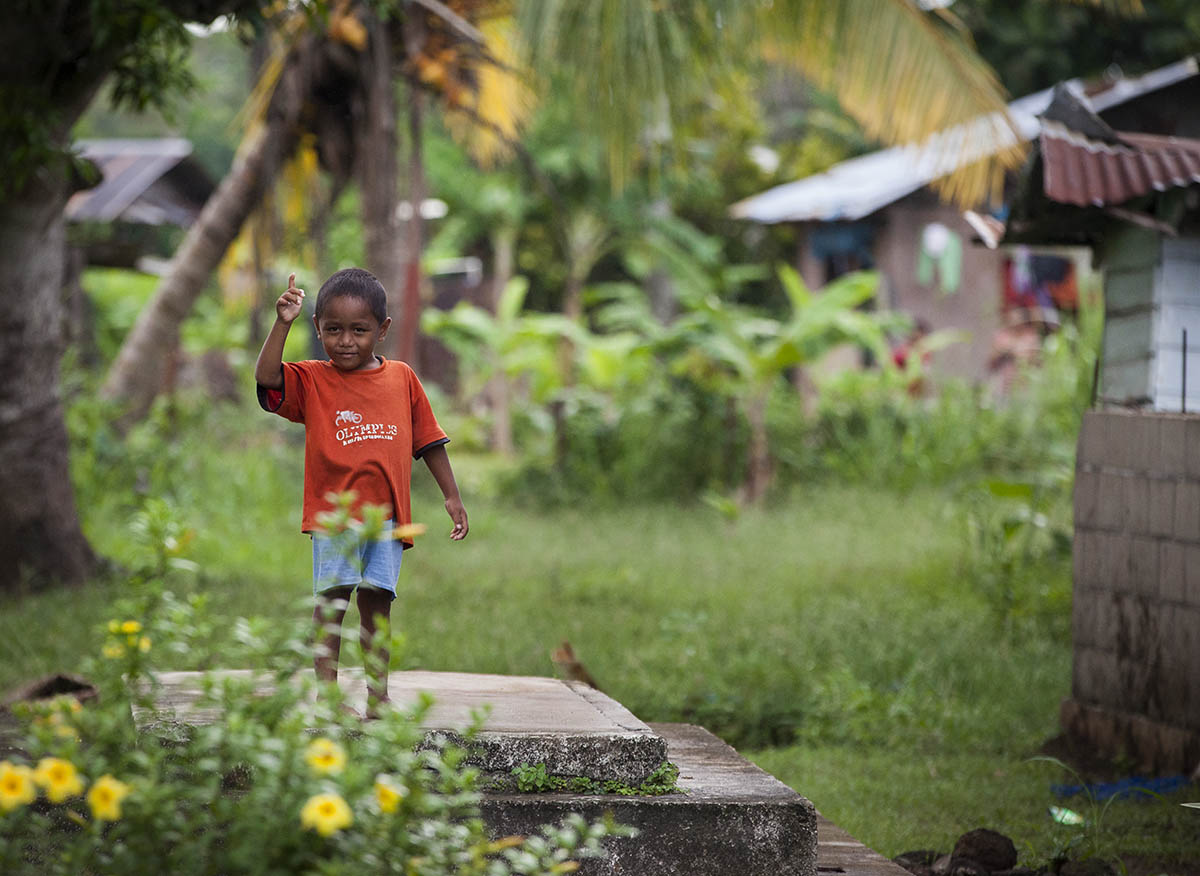
Talofa lava–a young boy waves in greeting.
The rains ceased. Clouds moved on, a pleasant breeze chasing them. The sun emerged from hiding. Children were the first to awaken, laughing and playing in streams winding back to sea. Steam rose above fluorescent flora. The world sparkled with brilliant color.
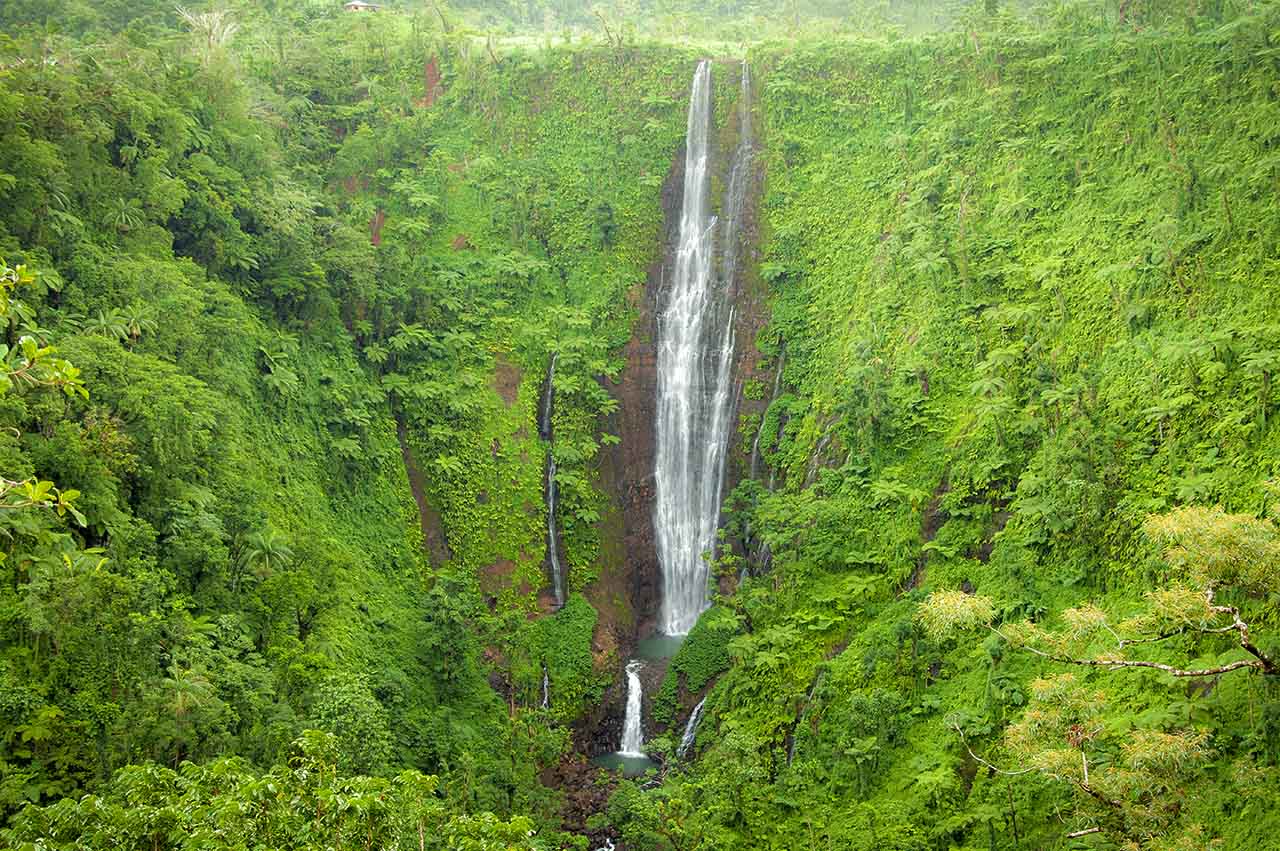
Rain and mountains make for spectacular waterfalls in Samoa.
I witnessed a transformation of the island, Samoa, sea, sky, land. What I didn’t see, couldn’t see then, was the change Samoa wrought in my heart, not until I left that place.
I have not been back, yet, I long to return, to reconcile the man I am with man I hope to be, in paradise.
Namu’a Island, Samoa, just a short swim away.
Gentle breezes blow through swaying palms in Samoan paradise.
Rain and mountains make for spectacular waterfalls in Samoa.
A woman walks home on a rural Samoan road.
Waterfalls and rain are never far away on Upolu, Samoa.
Samoan wildflower
Samoan wildflower
Samoan wildflower
Giant electric green ferns thrive in the Samoan forests.
Samoan wildflower
Lush vegetation of many colors grow in the Samoan jungle.
Lush vegetation of many colors grow in the Samoan jungle.
Tapa cloth designs create a homey warmth in the Samoan fale.
Rain drops bead on leafy green vegetation in Samoa.
Beautiful flowers grow wild in Samoa.
Coconuts grow wild on Upolu, Samoa.
A boy watches warily, before taking a swim in the ocean.
Samoan boy.
Samoan children pose for the camera.
Brothers, Samoa.
Fresh from a swim in the sea, a Samoan boy leans against his house.
Talofa lava–a young boy waves in greeting.
Coral reefs protect palm-lined sandy beaches on the island of Upolu, Samoa.
Lava flows bear witness to Samoa’s violent geological past.
Drift wood and lava adorn many Samoan beaches.
Put your feet in Samoan sand. You may not want to take them out.
Bench seats.
Perhaps in need of paint, the wooden canoe is still seaworthy.
Samoan canoe.
Hand carved canoes point the way for Samoan mariners.
Samoan Canoes.
Palm trees protect aging canoes from the sun and rain.
Known for centuries as great mariners, Samoan still navigate the seas in wooden canoes.
Peaceful bay in Upolu, Samoa.
Lava Lavas and sandals are formal attire in Samoa.
Storm clouds bloom over Upolu Island, Samoa.
Trade winds push fluffy clouds over coconut palms in Samoa.
A calm before the storm settles over the bay on Upolu, Samoa.




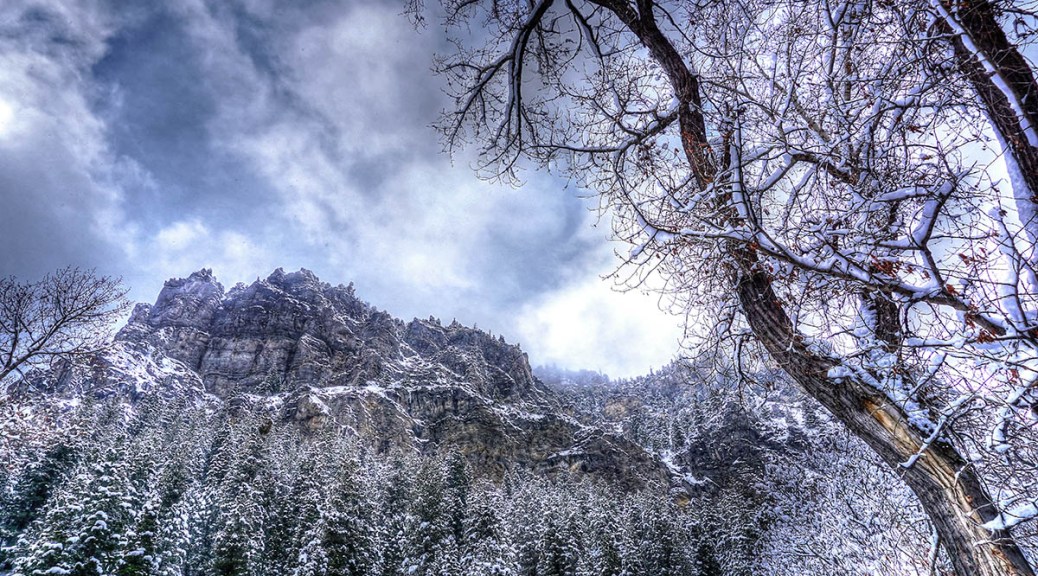
 I no longer live in the east. Yet the seemingly simple home spun lessons of the New England poet stay with me. The words resonate in my western surroundings in spite of their New England sensibilities. Frost’s poetic imagery transcends time and place. The inspiration I found in the New England woods is also to be found in the Wasatch Mountains.
 Whose woods these are I think I know.
 …He is all pine and I am apple orchard.




















 They're Calling To Me